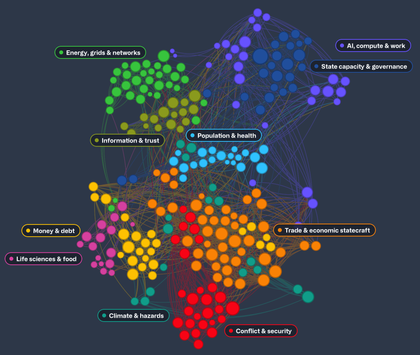


- Analysis of 80 National AI Strategies informed a single 20 part 'template' that all nations are scored against to reveal variations on where nations focus their attention
- Seven of the 20 areas are near-universal. No strategy is silent on vision, governance, research or talent, and nearly every strategy discusses ethics, data and public-sector use.
- The analysis revealed six 'AI Strategy Archetypes'. Frontier Contenders (2), Compute and Capital Hubs (11), Industrial Transformers (11), Trust and Public-Service Builders (28), Sovereignty Seekers (5) and Capacity Builders (23)
Since, 2019, I have personally read over 200 National AI Strategies (from cover to cover) and this year's update covers 80 National AI Strategies.
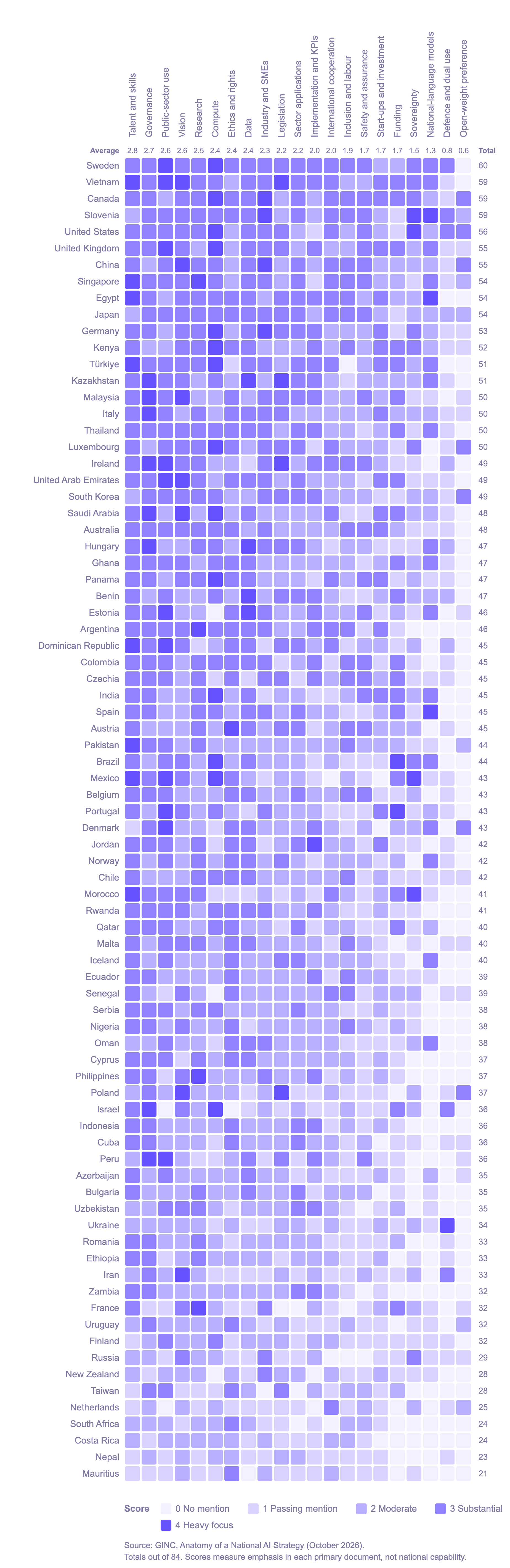
read the 80 national AI strategies in its October 2026 index against a single 20-part template and scored each part on a five-step scale, from no mention to heavy focus. The result is a 1,600-cell inventory of what governments say AI is for, and what they leave out.
National AI strategies are more alike than their branding suggests. Talent and skills (average 2.8 out of 4), governance and institutions (2.7) and public-sector adoption (2.6) appear in almost every document; no strategy is silent on talent, research, governance or vision. The typical strategy is a skills-and-institutions plan with a compute ambition attached.
The silences are as consistent as the commitments. Defence and dual use is absent from 33 of 80 strategies and seriously addressed in only six. Thirty say nothing about national-language models. Half the documents (41 of 80) commit no money or only gesture at it, and 22 have no real implementation or monitoring framework. A 21st area, open-weight policy preference, is thinner still: seven strategies give it substantial treatment, and 53 do not mention open models at all.
Six archetypes explain most of the variation. Two Frontier Contenders, 11 Compute and Capital Hubs, 11 Industrial Transformers, 28 Trust and Public-Service Builders, five Sovereignty Seekers and 23 Capacity Builders. What separates them is not whether they mention compute, ethics or skills, but which of those they put money and institutions behind.

Figure

Introduction
A national AI strategy is a statement of intent, but it is also a document with a recognisable skeleton. Most open with a vision and a ranking target, set up a council or agency, promise skills and research, and close with an action plan. Beneath that common shape, they differ sharply in what they treat as load-bearing: some are compute procurement plans with a preamble, some are ethics charters with a skills annex, some are industrial policies that happen to use the word AI.
This article dissects the 80 strategies counted in GINC's 80 National AI Strategies (October 2026). For each country, GINC scored the primary national document, read with the companion instruments the index treats as part of the current national approach (an AI statute, an action plan, a compute programme), against 20 areas that together describe what a national AI strategy can contain. Each area was shaded in five zones: 0, no mention; 1, a passing mention; 2, moderate treatment; 3, a substantial section with named measures, an owner or a budget; and 4, heavy focus, one of the document's central pillars with targets, money or institutions behind it.
The exercise answers three questions. What does a national AI strategy typically contain? Where do governments converge, and where do they leave gaps? And which kinds of country, by what their strategy is actually for, behave alike? The scores measure emphasis in the document, not national capability: a country can score low on compute in its strategy and still host large data centres, or score high on ethics and enforce little.
The Six Archetypes
GINC assigned each strategy to one archetype by asking what the document is for: the problem it treats as central and the area it backs with money or institutions. The six groups are not rankings. A Capacity Builder can have a more complete strategy than a Compute Hub; what differs is the purpose.
Archetype | What the strategy is for | Members | Signature areas (archetype average, 0–4) | Typical gap |
|---|---|---|---|---|
Frontier Contenders (2) | Leading at the frontier and setting global rules; capability, export controls and evaluation | United States, China | Vision 3.5, compute 3.5, industry adoption 3.5, sovereignty 3.0 | Funding and implementation (1.5): neither document attaches budgets or KPIs |
Compute and Capital Hubs (11) | Attracting compute, capital and firms; sovereign infrastructure and national champions | Canada, United Kingdom, Kazakhstan, Türkiye, UAE, Saudi Arabia, Luxembourg, Panama, India, Brazil, Israel | Compute 3.7, vision 3.1, governance 3.1, talent 3.1, funding 2.6 | Defence 0.9 and inclusion 1.6 |
Industrial Transformers (11) | Raising productivity in manufacturing and services; adoption, research and applied industrial AI | Vietnam, Germany, Japan, Thailand, Hungary, South Korea, Czechia, Portugal, Philippines, France, Taiwan | Research 2.9, industry adoption 2.8, governance 2.8, implementation 2.5 | Sovereignty 1.5 and defence 0.9 |
Trust and Public-Service Builders (28) | Trustworthy AI in government and society; citizen services, ethics and light regulation | Sweden, Singapore, Ireland, Italy, Malaysia, Australia, Austria, Dominican Republic, Estonia, Spain, Belgium, Norway, Chile, Rwanda, Denmark, Iceland, Qatar, Malta, Oman, Peru, Poland, Finland, Uruguay, New Zealand, Costa Rica, South Africa, Netherlands, Mauritius | Public-sector adoption 2.8, ethics 2.6, governance 2.6 | Funding 1.2, sovereignty 1.2, start-ups 1.4 |
Sovereignty Seekers (5) | Technological independence under sanctions, war or strategic exposure | Slovenia, Mexico, Ukraine, Iran, Russia | Sovereignty 3.0, vision 3.0, defence 2.4 | International cooperation 1.2, start-ups 1.2 |
Capacity Builders (23) | Laying foundations of skills, data and institutions; development and inclusion framing | Egypt, Kenya, Benin, Ghana, Argentina, Colombia, Jordan, Pakistan, Morocco, Ecuador, Nigeria, Senegal, Serbia, Cyprus, Indonesia, Bulgaria, Cuba, Uzbekistan, Azerbaijan, Ethiopia, Romania, Zambia, Nepal | Talent 3.0, governance 2.7, research 2.6 | National-language models 0.8, defence 0.5, sovereignty 1.0 |
Trust and Public-Service Builders are the modal persona: 28 of 80 strategies, from the Nordic states and Singapore to Peru and Rwanda. They contain two sub-types. One is the EU rule-taker (Italy, Ireland, Austria, Poland, Malta, Spain), whose strategy is shaped by the AI Act and spends its energy on supervisors, sandboxes and ethics. The other is the digital-government state (Estonia, Denmark, Singapore, Malaysia, Peru, the Dominican Republic), whose strategy is a plan to put AI into public services.
The Compute and Capital Hubs are the archetype that grew fastest in 2025–26. Canada (June 2026), the UK (January 2025), Türkiye (August 2026) and Panama (August 2026) all rewrote or added strategies whose operative core is compute and investment attraction, joining Brazil and Kazakhstan, whose 2024 plans already took that shape, as well as the Gulf states and India. Their average compute score (3.7) is the highest of any group on any single area.
Sovereignty Seekers are a small and mixed group. Russia, Iran and Ukraine are driven by sanctions or war; Mexico by a declared goal of reducing technological dependence through national infrastructure; Slovenia, unusually, by a March 2026 strategy that names sovereignty as its key emphasis (sovereign control over data, compute and Slovene-language models, within a strategically autonomous Europe). North Korea, which has no published strategy and is not counted, is the shadow member of this group: its inferred approach is sovereignty and defence without any civil document at all.
The boundaries are porous. China is placed with the United States as a Frontier Contender despite a document that reads as industrial policy; Taiwan is an Industrial Transformer on the strength of its Ten New AI Infrastructure Projects, though its AI Basic Act (passed 23 December 2025) is a governance statute; Sweden (a Trust Builder) carries compute and total-defence sections that would fit a Hub. Each assignment is a judgement about purpose, recorded in the data so others can disagree with it.
The profiles below describe each archetype in turn: the question its strategies are written to answer, the areas where its members score furthest above the 80-country average, the gaps they share and the range within the group. Figures are archetype averages on the 0–4 scale, with the all-country average in brackets.
Frontier Contenders
A Frontier Contender writes as if the country is, or can be, at the technological frontier, and writes for a global audience. Its subject is not adoption but leadership: who builds the most capable models, who sets the rules others follow and who controls the inputs. Only the United States (53) and China (52) qualify.
The pair stand furthest above the average on open-weight preference (3.0 against 0.6), sovereignty and supply chain (3.0 against 1.5), safety and assurance (3.0 against 1.7) and industry adoption (3.5 against 2.3). Both treat open models as an instrument of influence and both run evaluation through national-security rather than regulatory institutions. Their gaps are those of a document that sits on top of many others: funding and implementation (1.5 each) are thin because budgets and delivery live in executive orders, five-year plans and agency programmes, and ethics (2.0) and governance (2.5) fall below the average. The two differ in method rather than premise. The US plan is deregulatory and export-led, built around the 'full AI technology stack'; China's AI Plus Opinions are an adoption campaign across the whole economy. Both assume that AI capability is now a determinant of national power.
Compute and Capital Hubs
A Hub strategy is organised around attracting capacity: sovereign compute, data centres, investment and globally mobile firms and talent. The question it answers is where the infrastructure will sit and how to bring it home. Eleven countries fit, from G7 members (Canada 56, the UK 54) through the Gulf (the UAE 49, Saudi Arabia 48) and Central Asia (Kazakhstan 51) to large emerging economies (India 45, Brazil 44), a regional hub (Panama 47), a small European state (Luxembourg 47), Türkiye (51) and Israel (36, scored on press accounts of an unpublished plan).
Compute is the signature: the group averages 3.7 (2.4), and nine of the 11 make it a central pillar. Hubs are also the strategies most likely to put a price on their ambitions, with funding at 2.6 (1.7), start-ups and investment at 2.5 (1.7) and sovereignty at 2.2 (1.5). What they underweight is the social side: ethics (2.1), inclusion and labour (1.6) and implementation (1.8) all sit below the average, and defence (0.9) is barely present. This is the archetype that grew fastest in 2025–26, and its weakness is the gap between capacity announced and capacity built: much of the compute in these documents is committed rather than operating.
Industrial Transformers
An Industrial Transformer treats AI as productivity policy. Its strategy is about diffusing AI through manufacturing, services and small firms, backed by applied research and national champions. The question is how domestic firms will use it. The 11 members are mostly East and Southeast Asian (Vietnam 59, Japan 52, Thailand 50, South Korea 46, the Philippines 37, Taiwan 28) and Central European (Germany 52, Hungary 47, Czechia 45), with Portugal (43) and France (31).
The group scores above the average on industry adoption (2.8 against 2.3), research (2.9 against 2.5) and, most distinctively, implementation (2.5 against 2.0), the highest of any archetype. These are the documents most likely to arrive as action plans with numbered tasks, owners and update cycles, as South Korea's 99-task AI Action Plan and Czechia's annual action plans show. They also give national-language models more weight (1.7 against 1.3). Their gaps are outward-facing: international cooperation (1.7), sovereignty (1.5) and defence (0.9). The low totals for France and Taiwan partly reflect what could be read: France was scored on official summaries and Taiwan on a summary of its AI Basic Act.
Trust and Public-Service Builders
A Trust Builder's central promise is AI that citizens can rely on, delivered first through the state's own services. The question is how to use AI well and safely rather than how to lead in it. With 28 members it is the largest archetype and the most varied, running from Sweden (60), Singapore (52) and Ireland, Italy and Malaysia (49 each) to New Zealand (28), Costa Rica and South Africa (24), the Netherlands (23) and Mauritius (21).
It is the only group above the average on ethics, trust and rights (2.6 against 2.4), public-sector adoption (2.8 against 2.6), safety and assurance (1.9 against 1.7) and international cooperation together. It is weakest where money and hard capacity are needed: funding (1.2), start-ups (1.4), sovereignty (1.2) and compute (2.0) are all below the average. Two sub-types sit inside it. EU rule-takers (Italy, Ireland, Austria, Poland, Malta, Spain) spend their energy on supervisors, sandboxes and AI Act implementation; digital-government states (Estonia, Denmark, Singapore, Malaysia, Peru, the Dominican Republic) write what are, in effect, plans to put AI into public services. Many members are small open economies whose regulatory frame is set elsewhere, which helps explain why their strategies focus on use and trust rather than capacity.
Sovereignty Seekers
A Sovereignty Seeker writes its strategy under pressure, whether from sanctions, war or strategic exposure, and its question is how to avoid depending on others. The five members are the most mixed of any group: Russia (28) and Iran (33) under sanctions, Ukraine (34) at war, Mexico (43) seeking to reduce technological dependence through national infrastructure, and Slovenia (57), whose March 2026 strategy names sovereignty as its key emphasis within a strategically autonomous Europe.
They are defined by two areas: defence and dual use (2.4 against 0.8), the only archetype where defence rises above a passing mention, and sovereignty and supply chain (3.0 against 1.5). Vision is also strong (3.0). The cost of the inward turn shows in the gaps: international cooperation (1.2), data (1.6), start-ups (1.2) and inclusion (1.4) all fall well below the average. North Korea, which has no published strategy and is not scored, is the archetype's unacknowledged extreme: an inferred approach of sovereignty and defence with no civil document at all.
Capacity Builders
A Capacity Builder puts foundations first: skills, data, institutions and the sectors where AI can help development soonest. Its question is what must exist before AI can be used at scale, and its framing is usually development, inclusion and the Sustainable Development Goals. The 23 members span Africa (Egypt 54, Kenya 51, Benin and Ghana 47, Nigeria and Senegal 38, Ethiopia 33, Zambia 32), Latin America (Argentina 46, Colombia 45, Ecuador 39, Cuba 35), the Middle East and South Asia (Jordan and Pakistan 42, Morocco 41, Nepal 23), Indonesia (36) and a European and Central Asian group (Serbia 38, Cyprus 37, Bulgaria and Uzbekistan 35, Azerbaijan 34, Romania 33).
Talent is the strongest area (3.0 against 2.8), followed by governance and research. More surprisingly, the group scores above the average on implementation (2.3 against 2.0): many of these strategies come with action plans and indicator frameworks, Jordan's 68-project plan being the clearest case. Sectoral applications (2.3) and inclusion (2.0) are also above the average. The gaps are the areas that presuppose a large technology base: national-language models (0.8), defence (0.5), sovereignty (1.0), safety and assurance (1.3) and open-weight preference (0.3). The spread is wide, from Egypt's second-edition strategy, one of the most complete in the index, to Nepal's 2025 policy, scored on a press summary.
National AI Strategy Template
Across the 80 documents, 20 areas recur often enough to form a template. Seven of them are near-universal: no strategy is silent on vision, governance, research or talent, and at least 78 of 80 discuss ethics, data and public-sector use. Six are minority concerns, addressed substantially by fewer than a quarter of strategies. The table orders the areas by how much weight the average strategy gives them.
Figure 2. National Ai Strategies
Rank | Area | What it covers | Average (0–4) | Substantial or heavy (3–4) | Silent (0) |
|---|---|---|---|---|---|
1 | Talent and skills | Education pipeline, workforce training, numeric targets, attracting talent | 2.8 | 60 | 0 |
2 | Governance and institutions | Lead ministry or agency, council, coordinator, new bodies | 2.7 | 54 | 0 |
3 | Public-sector adoption | AI in government services, civil-service tools, procurement | 2.6 | 46 | 2 |
4 | Vision and ambition | National goal, ranking target, horizon | 2.6 | 41 | 0 |
5 | Research and R&D | Research funding, centres of excellence, universities | 2.5 | 41 | 0 |
6 | Compute and infrastructure | GPUs, supercomputers, data centres, energy, cloud | 2.4 | 36 | 3 |
7 | Ethics, trust and rights | Principles, transparency, bias, privacy, human-centric AI | 2.4 | 41 | 1 |
8 | Data | Open data, data governance, data spaces, national datasets | 2.4 | 42 | 1 |
9 | Industry and SME adoption | Adoption programmes, vouchers, sector digitalisation, productivity | 2.3 | 32 | 1 |
10 | Legislation and regulation | AI law, risk tiers, binding rules, sandboxes | 2.2 | 23 | 1 |
11 | Sectoral applications | Named priority sectors such as health, agriculture, education | 2.2 | 31 | 3 |
12 | Implementation and monitoring | Action plan, KPIs, timelines, review cycle, reporting | 2.0 | 26 | 2 |
13 | International cooperation | Diplomacy, standards, partnerships, summits | 2.0 | 19 | 3 |
14 | Inclusion and labour | Job displacement, inequality, gender, regions, SDGs | 1.9 | 21 | 3 |
15 | Start-ups and investment | Funds, incentives, scale-up support, foreign investment | 1.7 | 16 | 5 |
16 | Safety and assurance | Safety institute, model evaluation, testing, frontier risk | 1.7 | 19 | 3 |
17 | Funding and economic targets | Stated public money, GDP or jobs targets | 1.7 | 22 | 10 |
18 | Sovereignty and supply chain | Independence, chips, cloud dependence, export controls | 1.5 | 12 | 16 |
19 | National-language models | Local-language models, national LLM, linguistic data | 1.3 | 19 | 30 |
20 | Defence and dual use | Military AI, national security, dual-use controls | 0.8 | 6 | 33 |
21 | Open-weight policy preference | Stated preference for open-weight models: open release of national models, support for open model ecosystems | 0.6 | 7 | 53 |
The 21st area, open-weight policy preference, was added after the main scoring. It uses the same 0–4 scale and, with an average of 0.6, would rank last of all 21, below defence. It is not counted in the completeness totals, which cover the first 20 areas, and is discussed in Open and Closed Weights below.
The template has a clear centre of gravity. The four highest-ranked areas are the ones a government can deliver through its own ministries: training people, setting up a body, using AI in its own services and stating a goal. The four lowest are the ones that require money, hard choices or admitting strategic exposure: funding, sovereignty, national-language models and defence.
Compute is the area with the most heavy-focus scores. Fourteen strategies treat it as a central pillar (score 4), more than any other area; public-sector adoption follows with 11. Regulation, by contrast, is moderate almost everywhere: 46 strategies give it a section or several measures, but only four make binding law a central pillar.
The Inventory
[embed: node/4fc54973-06de]
Read left to right, the heatmap moves from what every strategy contains to what most leave out: the left-hand columns are dark almost all the way down, the right-hand columns pale. Read down, each archetype has a band where its colour concentrates, compute for the Hubs, public-sector use for the Trust Builders, talent for the Capacity Builders, sovereignty and defence for the Sovereignty Seekers. Hover over any cell for the country, area and score.
Reading the Inventory by Area
The universal areas are where strategies are least distinctive. Every document discusses talent, but only eight make it a central pillar. Six attach numeric targets: Pakistan ('1 million new and existing IT graduates' trained in AI by 2027), Morocco (200,000 AI talents trained and certified by 2030), Türkiye (10,000 advanced AI specialists and 100,000 AI application professionals), Egypt (30,000 AI professionals by 2030), Singapore (15,000 AI practitioners) and Mexico (capacity for 25,000 certifications a year). Vietnam and the Dominican Republic make talent central without a published headline figure. Governance is similar: the heavy-focus cases are those that created or empowered a dedicated AI body or network: Kazakhstan's Ministry of AI and Digital Development (by decree, September 2025), Israel's National AI Directorate in the Prime Minister's Office (September 2025), Hungary's network of ministerial AI commissioners, Ireland's statutory AI Office (2026), Italy's designation of the existing AgID and ACN as national AI authorities, Malaysia's AI Malaysia Berhad and Peru's requirement that every public entity designate an AI officer. Only Ireland's is a new body created by statute.
Compute is the most contested area, and the most bimodal. Fourteen strategies make it a central pillar: the United States, Canada, the UK, Germany, Sweden, Luxembourg, Saudi Arabia, Israel, Türkiye, India, Brazil, Mexico, Panama and Kenya. Another 14 mention it only in passing or not at all, including Estonia, Denmark, New Zealand, Czechia and Senegal. Few areas divide strategies as cleanly into those that plan to own capacity and those that plan to rent it.
Public-sector adoption is where small states lead. The 11 heavy-focus cases include the UK and the UAE, but also Estonia, Denmark, Portugal, Ireland, Peru, Mexico, Vietnam, Sweden and the Dominican Republic. For many governments the most credible near-term AI programme is the one they control: their own civil service.
Regulation is broad and shallow. Most strategies (46) treat it moderately, as principles plus a promise of rules. Only four make binding law central: Kazakhstan and Vietnam, whose AI laws of 2025 (in force in January and March 2026) now sit above their strategies, and Ireland and Poland, whose 2026 laws implementing the EU AI Act are the operative instrument. Safety and assurance is thinner still: 19 strategies treat it substantially, and none makes frontier-model safety a central pillar, not even the United States, whose plan treats evaluation as a tool of competitiveness and national security rather than of regulation.
The minority areas are where identity shows. National-language models are central only for Spain (the ALIA family), Slovenia and Egypt (a national Arabic large language model), and substantial in 16 more, mostly smaller-language states such as Iceland, Norway, Denmark, Estonia, Hungary and Ghana. Sovereignty is heavy only for the United States (export controls and the export of the 'full AI technology stack' under Executive Order 14320), Slovenia, Mexico and Morocco. Defence is a central pillar in only one strategy, Ukraine's: the 2020 concept remains formally in force, but the Brave1 defence-tech cluster, launched in April 2023, has become the de facto centre of its AI effort.
Money is the starkest omission. Only Brazil (R$23 billion to 2028, under its July 2024 plan) and Portugal (more than €400 million for 2026–2030, mostly EU funds) make funding a central pillar; 41 of 80 strategies attach no figures or only a passing reference. Implementation is weak too: Jordan's 68-project implementation plan, with indicators at both strategic-goal and project level, is the only strategy to score 4, while 22 documents, including those of the United States, India, Singapore and Israel, have little or no monitoring framework.
Reading the Inventory by Archetype
The archetypes differ less in breadth than in where they put weight. Summing the 20 scores gives each strategy a completeness total out of 80; the archetype averages run from 39 to 53, but the spread inside each group is wider than the spread between them.
Archetype | Average total (of 80) | Most complete | Least complete | Heaviest area | Lightest area |
|---|---|---|---|---|---|
Frontier Contenders | 52.5 | United States (53) | China (52) | Vision, compute, industry adoption (3.5) | Funding, implementation (1.5) |
Compute and Capital Hubs | 48.0 | Canada (56) | Israel (36) | Compute (3.7) | Defence (0.9) |
Industrial Transformers | 44.5 | Vietnam (59) | Taiwan (28) | Research (2.9) | Defence (0.9) |
Trust and Public-Service Builders | 39.4 | Sweden (60) | Mauritius (21) | Public-sector adoption (2.8) | Defence (0.6) |
Capacity Builders | 39.2 | Egypt (54) | Nepal (23) | Talent (3.0) | Defence (0.5) |
Sovereignty Seekers | 39.0 | Slovenia (57) | Russia (28) | Sovereignty, vision (3.0) | International cooperation, start-ups (1.2) |
Three readings stand out. First, the most complete strategies are not the most powerful countries' strategies. Sweden (60), Vietnam (59), Slovenia (57), Canada (56) and Egypt (54) all outscore the United States (53) and China (52). Comprehensive documents tend to come from countries that are writing for a domestic coalition and an EU or donor audience; the frontier states write narrower documents because their real strategy is spread across many instruments.
Second, each archetype has a fingerprint area that no other group matches. Hubs average 3.7 on compute; Trust Builders lead on public-sector adoption and ethics; Capacity Builders lead on talent; Sovereignty Seekers are the only group whose defence average (2.4) rises above passing mention. Industrial Transformers stand out on implementation (2.5): the Asian and Central European industrial strategies are the most likely to come with timed tasks and KPIs, as South Korea's 99-task AI Action Plan (February 2026) and Czechia's annual action plans show.
Third, defence is the lightest or near-lightest area for every archetype except the Sovereignty Seekers. Whatever their purpose, most governments write their AI strategy as a civilian document and handle military AI elsewhere, or not at all in public.
Open and Closed Weights
Whether a country builds on open-weight models (whose trained parameters are published and can be run, adapted and audited locally) or on closed models reached through a vendor's interface is one of the most consequential choices in national AI policy. It decides who controls the model, where data goes and how easily a state can change supplier. GINC therefore added a 21st area, open-weight policy preference, scored on the same 0–4 scale as the other 20: 0 for no mention of open models; 1 for a passing mention; 2 for an explicit measure or principle; 3 for a dedicated section with named measures, an owner or a budget; and 4 for a central pillar. References to open-source software or open data on their own do not count.
It is the thinnest area in the inventory. The average is 0.6, below defence (0.8); 53 of 80 strategies say nothing about open models, and none makes them a central pillar. Seven score 3. The United States has a dedicated section, 'Encourage Open-Source and Open-Weight AI', which aims to ensure the country has 'leading open models founded on American values'. China's AI Plus Opinions include a section on building a thriving open-source ecosystem of models, tools and datasets. Canada's June 2026 strategy has a section on 'Advancing Open-Source AI for Resilience and Choice', pledges to lead a global effort to sustain open-source AI and is the only strategy to frame the choice explicitly against proprietary lock-in. Poland's policy has a section on open-source models built around its PLLuM and Bielik language models. Denmark funds open Danish language models (DKK 20.7 million), Luxembourg has a sub-section encouraging public bodies to prioritise open-source models, and South Korea ties funding for its national foundation-model programme to how openly the models are released.
Six more score 2 for a single explicit measure or principle. Pakistan sets out an open-source AI governance framework and aims to contribute about 50 models a year to open platforms; Singapore notes that its SEA-LION and MERaLiON models were open-sourced; Japan aims at an ecosystem that includes open-weight models; Slovenia expects publicly funded models to be openly accessible in principle; Uruguay commits to promoting open-source AI systems; and the Netherlands will promote open and European language models. Fourteen more mention open-source models or tools only in passing, among them the UK, Germany, France, Italy and Russia.
The preference cuts across archetypes but not evenly. Both Frontier Contenders score 3, for competing reasons: the United States to spread an American technology stack, China to build an ecosystem around its own models under chip controls. Hubs, Industrial Transformers, Trust Builders and Sovereignty Seekers all average about 0.6, and Capacity Builders 0.3; for most developing-country strategies the question has not yet arrived. Where the preference does appear outside the frontier states, open weights are sovereignty by another route: a base model that a mid-sized or smaller-language state can host, adapt and audit without depending on one foreign vendor. Many strategies that fund national language models, among them Spain, Egypt, Sweden, Iceland, Brazil and Malaysia, say nothing about whether the weights will be published; Spain's ALIA models have in practice been released openly, but the strategy does not commit to it.
Closed weights have no champion. No strategy argues for closed models as a policy preference, and none discusses the security case against releasing powerful model weights, even though that question dominates frontier-safety debate; the US plan leaves the release decision to developers. In most countries the open-or-closed choice is made implicitly, through procurement and partnership deals, rather than in the strategy itself.
This area rests on searches of each primary document for open-source and open-weight language in its original language. Documents for Costa Rica, Hungary, Iran, Israel, Mexico, Morocco, Nepal, Oman, Romania, Türkiye, Ukraine and Vietnam were unpublished or could not be read in full, so their 0 means 'not found in the document as read'. Peru's 1 rests on the resolution that approves its strategy, and South Korea's 3 on the science ministry's description of the programme, because the plan document itself could not be opened.
What is Missing
Five gaps recur so often that they describe the genre rather than individual countries.
- Money. Half the strategies (41 of 80) state no budget or only gesture at one, and ten say nothing about funding at all. Strategies are written by ministries that do not control appropriations, so they promise programmes and leave the price to annual budgets. GINC's credibility tiers track the same gap from the other side.
- Measurement. Twenty-two strategies have little or no implementation or monitoring framework, and only Jordan's attaches indicators to every project. Without KPIs, the next edition of a strategy cannot say whether the last one worked.
- Defence and dual use. Thirty-three strategies are silent on military or security uses of AI, and only six treat them substantially (the United States, Israel, Sweden, Slovenia, Ukraine and Iran). Most governments keep military AI in separate, often classified, documents; the civil strategy then reads as if the state's largest AI customer did not exist.
- Language. Thirty strategies say nothing about models in the national language, including several large non-English-speaking states. For smaller-language countries in particular, the absence leaves their citizens dependent on models trained mainly on other people's text.
- Sovereignty and supply chains. Sixteen strategies ignore dependence on foreign chips, cloud and models, and only 12 treat it substantially. Export controls, licence conditions and hyperscaler terms now shape national AI capacity more than most strategy texts acknowledge.
Three further areas are thinner than the policy debate would suggest. Safety and assurance receives substantial treatment in only 19 strategies, and none makes it a central pillar; the network of AI safety and evaluation institutes is growing faster than the strategies that mention it. Start-ups and investment are also thin (16 substantial), which sits oddly beside the ambition statements of most documents. Open-weight policy is the thinnest of all (average 0.6): only seven strategies state a substantial preference for open models, and none weighs the case for keeping powerful weights closed.
The pattern is consistent with how strategies are made. They are written to build coalitions, signal intent and organise ministries, so they are strongest on what governments can promise without spending or choosing: skills, councils, principles and public-sector pilots. They are weakest where a strategy would have to name a price, a trade-off or a vulnerability. Readers comparing national AI strategies should read the gaps as carefully as the pillars.
Method and Sources
The 80 countries are those counted in GINC's 80 National AI Strategies (October 2026), with the same primary documents. North Korea, which has no published strategy, is not scored. For Finland, which has no standalone strategy, the government programme's AI commitments and the April 2026 measures (a fast-track review of AI in public services and a national AI adviser) were scored as a functional equivalent.
Each strategy was read by one of eight reviewers between 7 and 8 October 2026 against a common rubric of 20 areas and five zones (0 no mention; 1 passing mention; 2 moderate; 3 substantial, with named measures, an owner or a budget; 4 heavy focus, a central pillar with targets, money or institutions). Scores measure emphasis in the document and its named companion instruments, not national capability or delivery. The archetype is a single judgement about the strategy's purpose; China (scored as industrial in form) was placed with the United States as a Frontier Contender, and Taiwan was placed with the Industrial Transformers on the strength of its Ten New AI Infrastructure Projects.
The 21st area, open-weight policy preference, was scored on 8 October 2026 in a separate pass that searched each primary document for open-source and open-weight language in its original language. It uses the same 0–4 scale but is left out of the totals, so that the completeness figures cover the same 20 areas for every country. The same day, the article's quoted figures, dates and institutional claims were checked against primary sources and corrected where they differed.
The full primary text was available for roughly half the countries. Where a document was blocked, unpublished or available only in summary (among them Brazil, South Korea, Türkiye, Russia, Ghana, South Africa, Mauritius, Nepal, Mexico, Israel, France and the Netherlands), the score rests on an official summary, the OECD.AI record or reputable secondary reporting, and low scores for those countries may understate the full text. Scores of 0 should be read as 'not found in the document as read'.
The complete 80 × 20 dataset, with archetypes and totals, is in the Chart Data section above and can be reused under GINC's usual terms.