
What eighty years of the General Debate show
The complete verbatim record of every nation's annual statement to every other nation, across eighty sessions. This section sets out what the corpus supports, separated throughout from what it does not yet support.
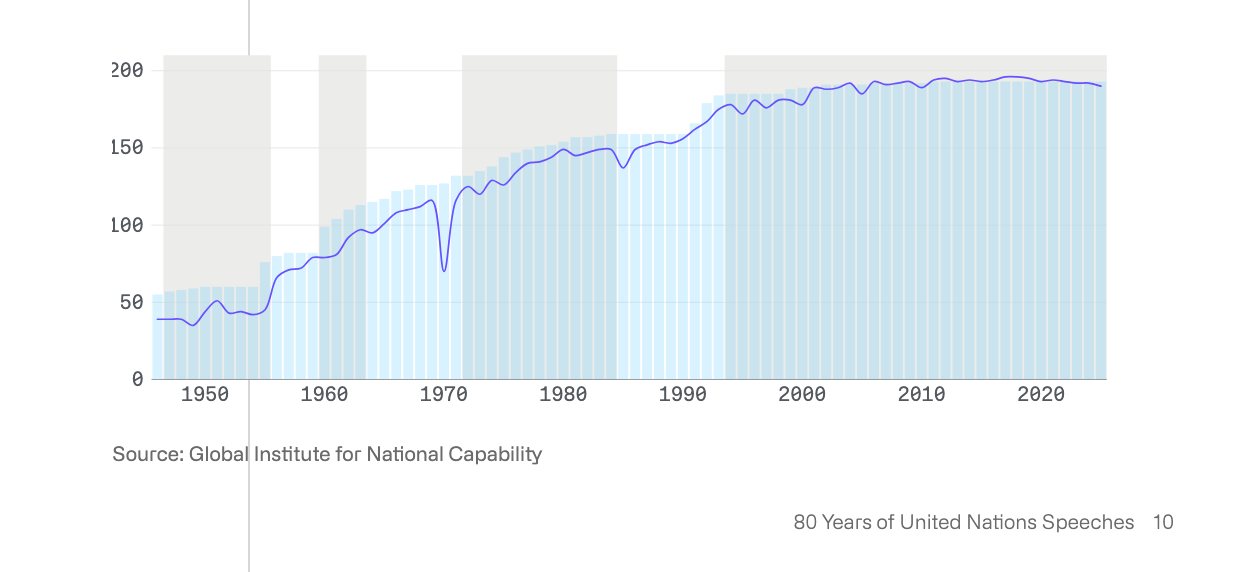
Eight eras, not eight decades. Membership and speech volume move in punctuated shocks rather than smooth trends: the 1955 package deal, the 1960 wave and the 1991–93 successions. Decade blocks manufacture a gradualism the record does not contain, and the era scheme is cut on the membership clock instead.
The vanished states. Yugoslavia, Czechoslovakia, South Yemen and East Germany left complete rhetorical lives in the record, which makes the corpus the only systematic behavioural archive of states that no longer exist. In 1964 the Article 19 financing crisis suppressed roll-call voting for an entire session, leaving speech as the sole systematic account of state positions that year.
The twenty-minute norm. The average General Debate speech runs comfortably beyond the Assembly's notional fifteen-minute guidance in every era of the record. Length is not drift: each era delivers its argument at the length that era considered the argument to deserve.
The mission. Language models have made speech conversable and, unanchored, they cite speeches that were never given. The Sovereign Speech Index is intended as the anchor: an open reference against which any answer about what a nation said can be checked on the verbatim record.
Figure 1.1 — Speakers and the Membership
The Eight Eras
The membership clock, and what each period is named for.
1. Formation, 1942–1946. The name precedes the institution. 'United Nations' first described the wartime alliance of January 1942. The Charter was signed in San Francisco in 1945. The first General Debate opened in London in January 1946, with 51 founders. The record starts with the victors' anxieties and the survivors' hopes.
2. Deadlock, 1947–1955. Each superpower vetoes the other's candidates, and admissions freeze for nearly a decade. Around 60 states exist, but only about 40 have a voice. Korea supplies the vocabulary, and the waiting room outside supplies the politics. The earliest sessions also raise the capture question: how much of what was said survives in the record.
3. The Package Deal, 1955–1959. Resolution 995 (X) breaks the freeze, admitting 16 states at a stroke. The entering class delivers its first speeches against Suez and Hungary, debuting into crisis. The Assembly begins tilting away from the chamber its founders designed.
4. Africa Takes the Floor, 1960–1963. Seventeen states join in a single session and membership passes 100. The rostrum acquires new accents and new grievances in its most theatrical season. The Congo tests the institution the newcomers have just joined, and by 1963 the continent has organised itself.
5. The New Majority, 1964–1971. The countries admitted since 1955 now outnumber the founders, and in 1964 they begin acting as a bloc. The G77 forms that year, the same year the Article 19 crisis leaves the Assembly able to speak but not to vote, making the debate the sole record of state positions. The gap between joining and speaking closes, and the era ends with Resolution 2758 reseating China.
6. The Age of Demands, 1972–1984. Both Germanys arrive, then the Portuguese wave. Whatever the East–West weather, from détente to renewed confrontation, the rostrum's dominant axis runs North–South. The New International Economic Order supplies the vocabulary, and the era its greatest volume of speech.
7. New Thinking, New States, 1985–1993. Membership flatlines while the language turns: new thinking from Moscow, then rupture. Twenty-five states arrive in three years as four vanish. The corpus preserves the last words of Yugoslavia, Czechoslovakia, East Germany and South Yemen beside the first words of their successors.
8. Universal Assembly, 1994–2025. From Palau to South Sudan the roll completes at 193 and holds. Membership stops moving; the world does not. A debate is postponed in 2001 and held virtually in 2020, and three decades of contest are carried in the chapters that follow. Session 80 closes eight decades of the record.
The Membership Waterfall
Figure 1.2 — The Membership Waterfall
Evolution
Two clocks on the same eighty years, and where they disagree.
This report cuts eighty years into eight eras on the membership clock: Formation, Deadlock, the Package Deal, Africa Takes the Floor, the New Majority, the Age of Demands, New Thinking and Universal Assembly. The cuts fall where the roll moves, at the 1955 package deal, the 1960 wave and the 1991–93 successions, because membership is the one property of this institution that changes in steps rather than by degrees, and a boundary that can be pointed to is a boundary that can be defended.
The speeches, left to themselves, cut the record elsewhere. A change-point test run on what the chamber actually talks about returns seven periods, only one of whose boundaries lands on a membership boundary. The chart below sets the two clocks side by side.
The thematic eras run as follows. The Founders' Order, to 1956, is the chamber of the charter and the freeze. Sputnik and Sovereignty, 1957 to 1971, runs from the first satellite to Resolution 2758. The Sea and the South, 1972 to 1982, covers the New International Economic Order and the law of the sea. The Long Liberal Turn, 1983 to 1999, spans the late Cold War and its aftermath as a single stretch. Goals and Terror, 2000 to 2019, holds the Millennium Declaration and the war on terror together. The Pandemic Interval runs three years, and the AI Rupture begins in 2023.
Figure 1.3 — The Two Architectures
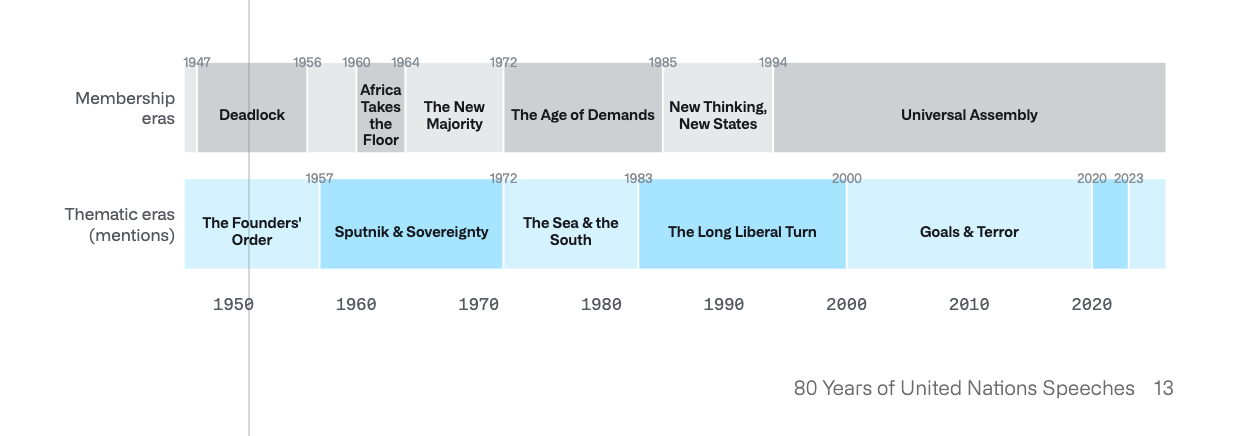
The disagreement between the two schemes is itself a finding. The membership clock places the great break at 1960, when seventeen states join in a single session; the thematic clock passes 1960 without a cut and breaks instead in 1957, with Sputnik. The membership clock treats 1994 to 2025 as one era, the roll having stopped moving, while the thematic clock cuts that same stretch three times.
Set side by side, the two tempos are close to mirror images. The membership scheme places five of its eight boundaries before 1972 and then runs a single thirty-two-year era to the present. The thematic scheme does the reverse: two eras cover the first twenty-six years, while the last six years alone contain two, the Pandemic Interval of three years and the AI Rupture beginning in 2023. One clock fragments the early record and holds the recent one together; the other holds the early record together and fragments the recent one.
That asymmetry follows from what each clock measures rather than from any artefact of method. Admissions were an event of the middle of the century and have almost ceased: the roll has gained six members since 1994 and none since 2011, so a scheme cut on membership has nothing further to cut on. Subjects behave in the opposite direction. The agenda has broadened in every decade, and a broader agenda offers a change-point test more places to find a break.
Two readings of this are available and the report declines to choose between them. Either what a chamber talks about is driven by the world rather than by who is in the room, in which case the membership scheme is a convenience and the thematic scheme is the history; or the membership cuts are real and slow-acting, with the arrival of a bloc changing what is said for a generation afterwards, in which case the thematic cuts sit above them. The 1960 case is the sharpest test available and it does not settle the question: the thematic break arrives three years early, which is consistent either with Sputnik pre-empting decolonisation or with decolonisation taking three sessions to reach the podium.
What can be stated is narrower and firmer. The 1955–56, 1960–61 and 1990–92 cut points are shared by every candidate scheme tested, so the spine of the periodisation holds however it is derived. Beyond those three, boundaries move with the method. A change-point test returns boundaries whether or not any exist, and the thematic era names are descriptive labels for the stretches it returned rather than claims about cause. Era labels are used here as a frame, and where a finding depends on which scheme is used the page states so.
Thematics
What the chamber talked about, family by family, and what moved.
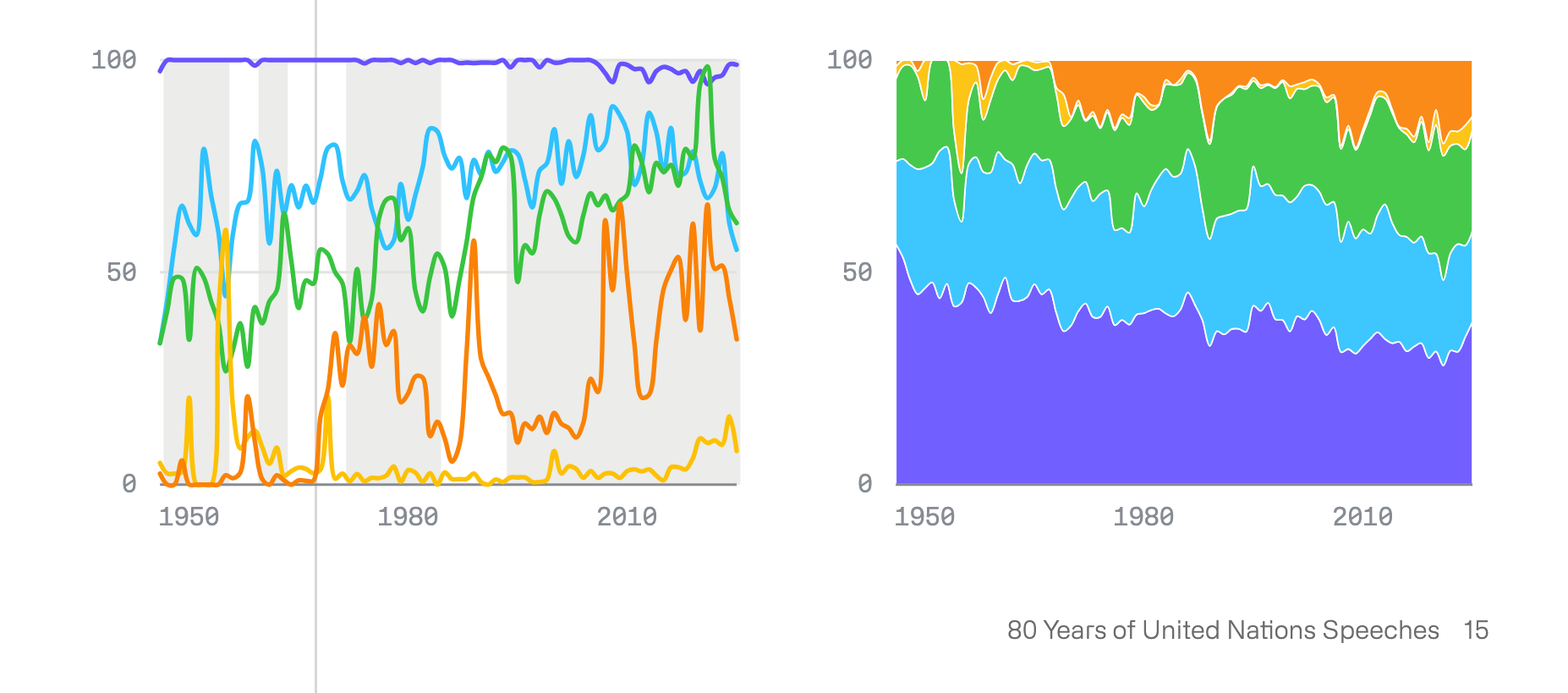
The five families do not take turns. Almost every speech in almost every year raises geopolitical language, and the movement in the record is in what accompanies it rather than in what replaces it. The paragraphs below take each family in turn, reading share of speeches at developed level or above.
Geopolitics. Geopolitics is raised in 97 to 100 per cent of speeches in every year of the record and is the only family never to fall below nine in ten. Its composition changes considerably even where its level does not: sovereignty and weapons give way to conflict and terrorism, while multilateralism holds first place throughout.
Economics. Economics records the steepest early climb of any family, from a third of speeches in 1946 to three-quarters by 1960, tracking the arrival of members for whom development was the reason to hold the floor. It has receded since, though its peak years coincide with the longest speeches in the corpus.
Environmental. Environmental language is absent at the founding, at zero in 1947 and 1.3 per cent as late as 1960. It arrives between 1960 and 1975, is given definition by the Brundtland Report in 1987, and is now the fastest-climbing family in the era rankings.
Societal. Societal language is the quietest family for three decades, at 27 per cent in 1955, and then makes the largest single jump in the record. Health carries most of that movement, reaching 93 per cent of speeches in 2021.
Technological. Technological language is the most volatile series in the report. It reaches 60 per cent in 1955 during the atomic-energy sessions, falls quiet for decades, and is the only family whose average rank is lower today than at the founding.
Figure 1.4 — The Five Families, Side by Side
The Era Rankings
Every theme's rank by developed+ share, era by era.
The chart below ranks all twenty-two themes within each of the eight membership eras by the share of that era's speeches raising them at developed level or above. Ranking rather than share is used deliberately, since every theme's raw share rises as speeches came to cover more ground, so shares flatter the present while rank leaves the order of priorities.
The first result the chart delivers is how little the top of the table moves. Multilateralism, law and UN reform is first in the founding era and first in the present one, and never leaves the top two in between. Armed conflict ends second and geopolitical order fifth. The subjects the institution was built to handle continue to take most of its speech.
Beneath that stable head, the middle of the table churns. Climate climbs eight places, terrorism seven and health six, while digital society falls seven and sovereignty six. The lines that cross the frame do so between roughly the fourth and the eighteenth positions, which is where the argument of the last eighty years has been conducted.
One qualification applies to the lower half of the chart. In the founding era only twelve themes were raised at all, so positions 13 to 22 are ties at zero share ordered arbitrarily, and a line beginning near the bottom may never have been raised. The page opposite reads the chart in full.
Figure 1.5 — The Era Rankings
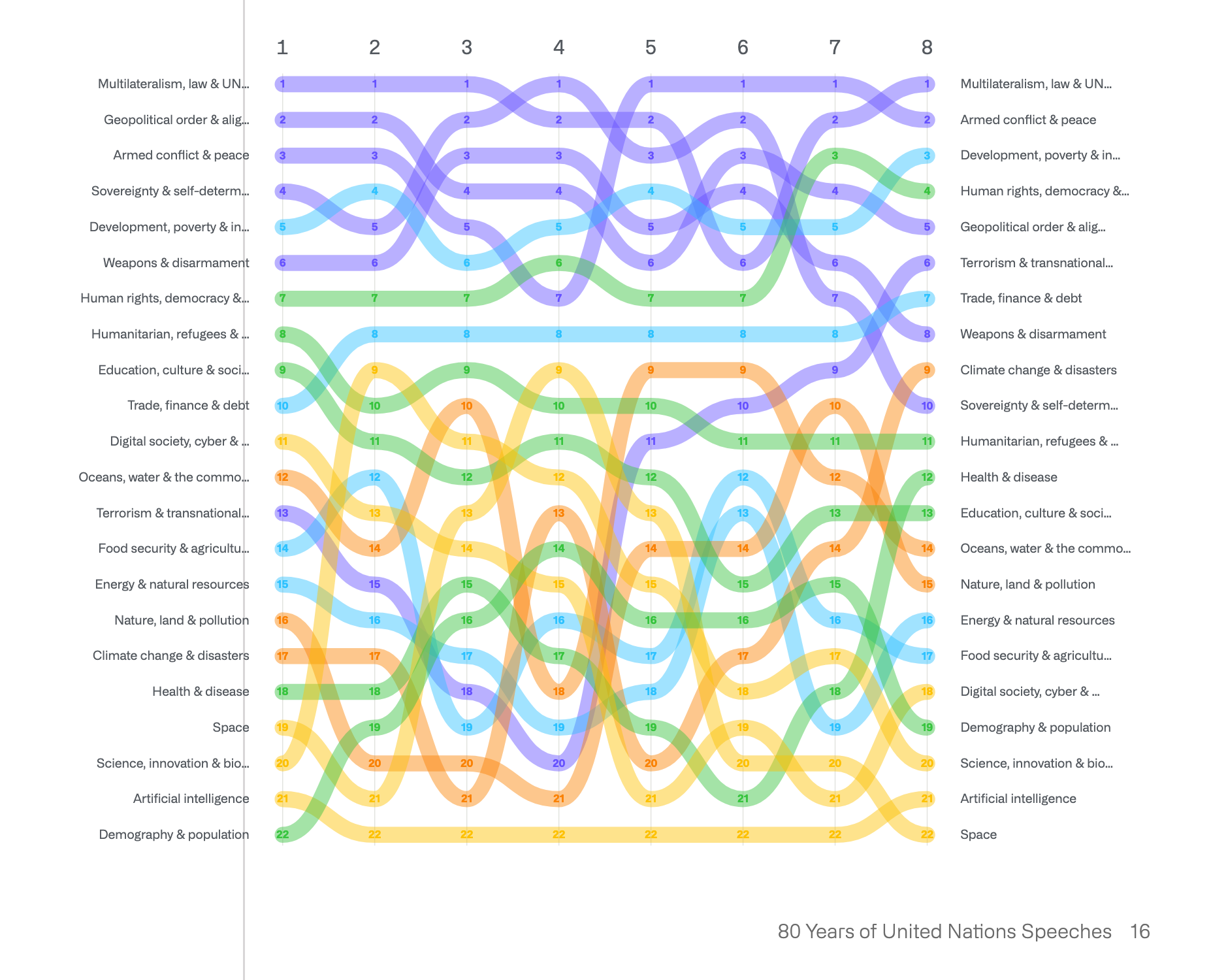
The colour groups. Each line is coloured by its parent family, and the families move as blocks. Environmental themes improve most, their average rank rising from 15.0 in the founding era to 12.7 in the present one. Societal themes gain a place on average, economic themes are flat, and geopolitical themes give up half a place while still occupying four of the top six. Technological themes are the only family to lose ground, falling from an average of 17.8 to 20.2, a result that runs against most expectations of the period.
The top of the table. Multilateralism, law and UN reform holds the best average rank in the record at 2.0, followed by armed conflict and peace at 2.9, geopolitical order at 3.8, sovereignty at 4.2 and development at 4.6. Five subjects, four of them geopolitical, account for almost the whole of the top of the table across eight eras, and no theme outside that group has finished an era in first place.
What climbs. Climate change and disasters records the clearest ascent in the chart, from seventeenth in the founding era to ninth today, rising in six of the seven transitions. Terrorism and transnational crime climbs from thirteenth to sixth, almost all of it after 2001; health and disease from eighteenth to twelfth; human rights from seventh to fourth; and trade, finance and debt gains three places. These are the subjects the chamber added to its standing agenda rather than merely mentioned.
What dips. Digital society, cyber and information records the largest fall in the chart, from eleventh to eighteenth, since the chamber was already discussing information and broadcasting at the founding and the modern digital agenda has not yet restored the position. Sovereignty and self-determination falls from fourth to tenth, which reflects decolonisation completing rather than sovereignty ceasing to matter. Education falls four places, with humanitarian language and food security three each.
Artificial intelligence. Artificial intelligence sits twenty-first of twenty-two in the founding era and twenty-first today, which reads as eighty years without movement. It is not. Its founding-era position is a tie at zero, since no speech mentioned it and the rank is an artefact of ordering, whereas its present position rests on a measured value for the first time, at 0.4 per cent of speeches at developed level. The diffusion record is sharper still: the first speakers appear in 2019 at half a per cent, the figure holds flat through 2022, and it then moves to 4.2 per cent in 2023, 8.3 per cent in 2024 and 10.5 per cent in 2025.
The reading this supports is that artificial intelligence has not yet emerged in the rankings while it has unmistakably begun to emerge in the record beneath them. A twentyfold rise concentrated in three sessions is the steepest arrival of any theme in the corpus, climate included. Rank is the conservative measure and will be the last to move; on the present trajectory the theme reaches the middle of the table within an era, though the report does not forecast, and the 2025 reading rests on three years of data rather than on a trend.
Voices
Seven ways of speaking, assigned nation by nation, year by year.
Part 4 asks who is speaking rather than what is spoken about, and reads the chamber six ways: the personas below, the long divergence of the hall from itself, the diffusion of subjects across the membership, the women who reach the rostrum, the small states that hold more of the floor than their weight would predict, and the blocs. Three of the six are summarised here.
Every nation-year is assigned to one of seven personas by nearest centroid on its theme profile. A persona is a way of speaking in a given year rather than a bloc or a fixed identity, and most countries change persona between eras. Four of the seven persist sufficiently to be read as standing voices.
The Assembly Mainstream. The largest of the seven and the default voice of the General Debate. Its signature is deliberately mild, with human rights and development a little above the level of the room and geopolitical order below it. Liberia holds it for seven eras of eight, and Guinea and Cameroon for every era they attend.
The Power Players. The most persistent of the seven: 57 per cent of its members are still in it an era later. Geopolitical order sits far above the level of the room, weapons above it, and human rights and development far below. Russia and Belarus hold the persona in all eight eras, with Ukraine, Poland, Hungary, Romania, France and China behind them.
The Front Line. Humanitarian language, refugees and migration sit far above the level of the room, armed conflict above it, and trade and development well below. Its persistent members are Middle Eastern without exception: Lebanon in all seven of its eras, Jordan in all six, then Sudan, Saudi Arabia and Israel.
The Commons Keepers. Oceans, water and the commons sit far above the level of the room, followed by energy and climate, while armed conflict is its lowest theme of all. It is not exclusively an island persona: Peru, Bolivia and Paraguay each hold it for five eras or more.
Figure 1.6 — Personas per Year
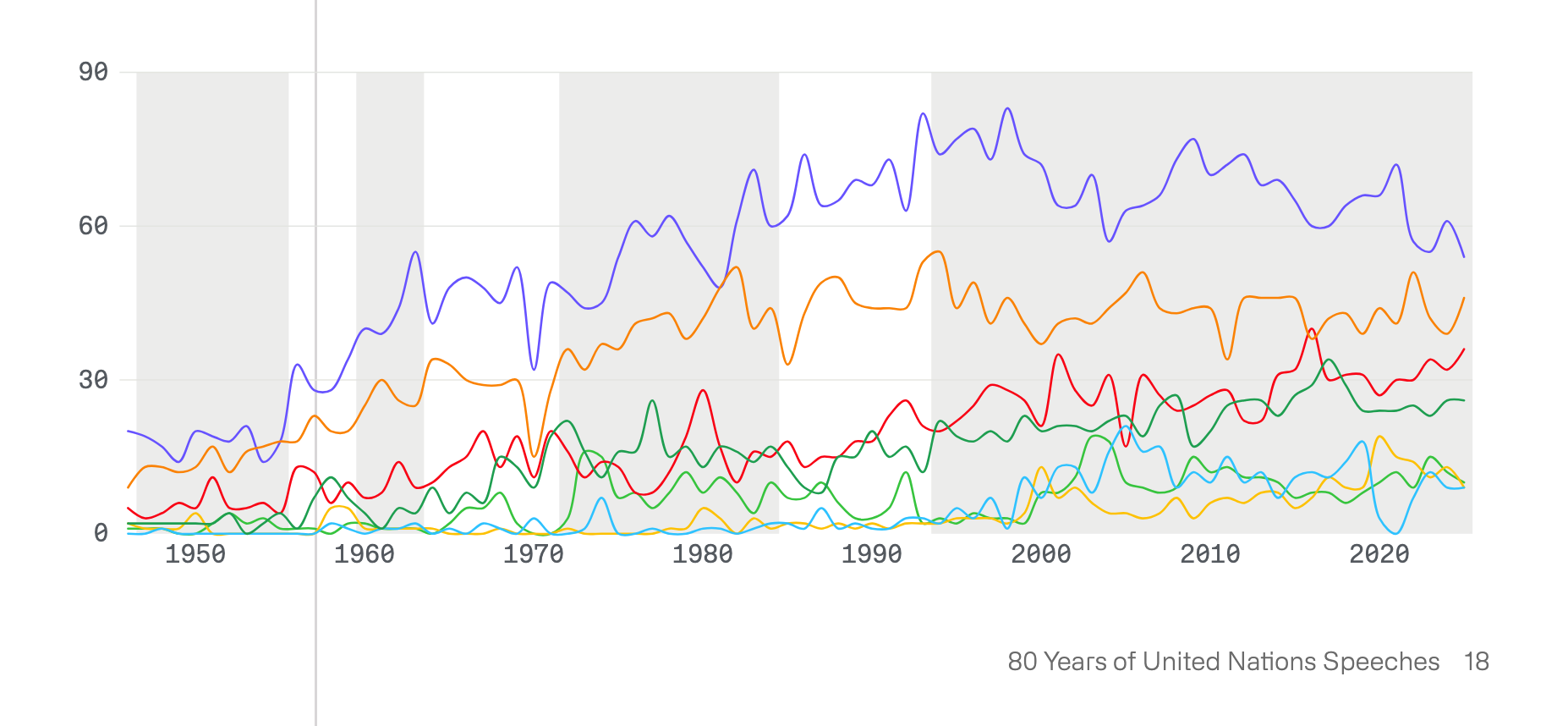
The remaining three personas are episodes rather than identities. Each carries a narrow and extreme signature, and each holds almost none of its members from one era to the next.
The Agrarian Voice. Food security sits more than three standard deviations above the level of the room, with development and trade behind it and geopolitical order last. Only 12 per cent of its members remain an era later. It peaks at 19 nations in 2003 and describes what a delegation sounds like in a year of drought.
The Modernisers. The smallest and least stable of the seven, holding 3 per cent of its members from era to era. Digital society dominates the signature, followed by science, space and artificial intelligence. It peaks at 19 nations in 2020 and represents a stance taken for a session rather than a standing identity.
The Health Champions. Health and disease sits more than four standard deviations above the level of the room, with little else in the signature. The persona is empty in most years before 1970, peaks at 21 nations in 2005, and returns whenever the chamber has an epidemic to discuss.
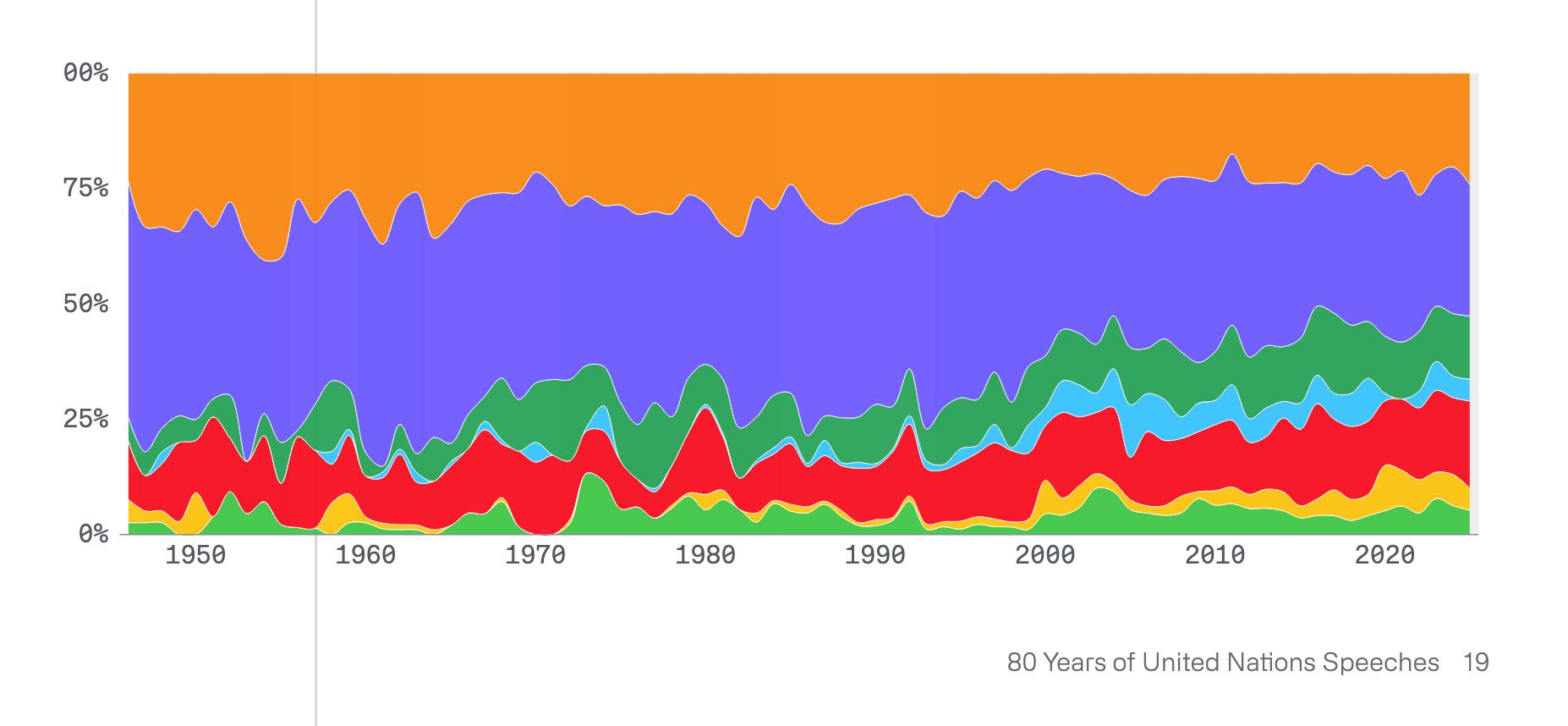
Read as shares rather than as counts — the chart below, stacked to 100 per cent — the composition of the hall shows a movement the counts conceal. The Assembly Mainstream takes 51 per cent of speakers in 1946 and peaks at 57 per cent in 1963, when decolonisation fills the room with members who sound broadly alike. It has fallen in every era since, to 28 per cent in 2025.
What the mainstream loses, the specialists take. The Front Line rises from 9 per cent in 1960 to 19 per cent today, and its 40 nations in 2016 are the highest in the record. The Commons Keepers rise from 5 per cent at the founding to 14 per cent, peaking at 34 nations in 2017 on a curve that tracks small-island admissions and the arrival of the climate agenda together.
The Power Players are the exception in both directions, at 41 per cent in 1954 and 24 per cent now, but with the same 46 nations by count and the strongest hold on their members of any persona in the set.
Figure 1.7 — The Hall in Personas
Convergence and Diffusion
Speech similarity against agenda breadth, and how subjects spread.
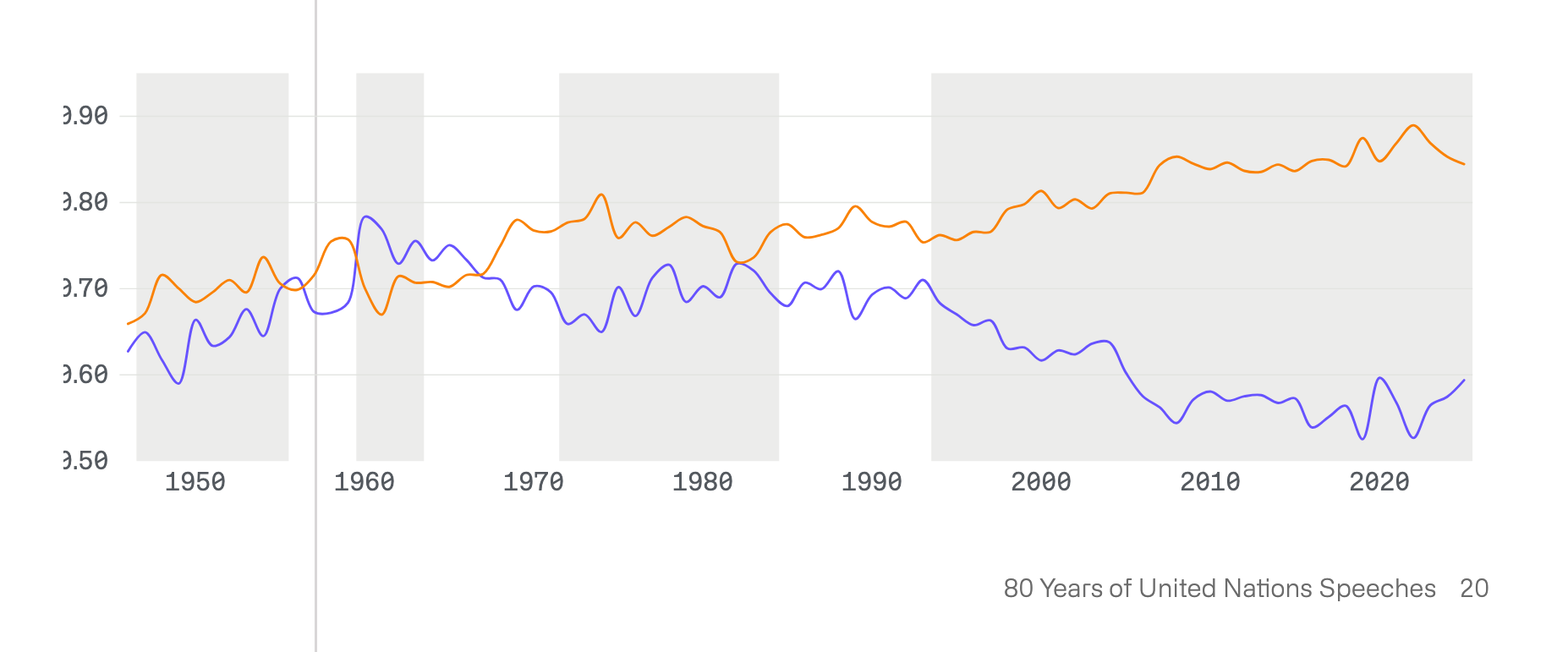
The two lines below approach the same question from opposite directions. The first is the mean similarity between any two speeches given in a year; the second is the breadth of the agenda those speeches cover. If the Assembly were homogenising, similarity would rise and breadth would fall. The record shows the reverse.
Similarity peaks in 1960, at 0.78, in the same session that seventeen newly independent African states took their seats, so the moment the chamber becomes something close to universal is also the moment its members sound most alike. It has fallen in almost every decade since, to a record low of 0.53 in 2019 and 0.59 today. Breadth runs in the opposite direction, from its own record low in 1946 to a peak of 0.89 in 2022.
Where that divergence sits is answered in Voices: not between the regional groups, whose similarity has barely moved in eighty years, but within them.
Diffusion asks the same question of subjects rather than of speakers, measuring how far across the membership each one spreads. Speed and ceiling prove to be independent of one another. Terrorism reaches almost the whole floor in the single session after 2001; climate takes fifty-seven years from first mention to near-universal adoption; and space is taken up quickly, by a fifth of the hall, and then stops.
Figure 1.8 — The Long Divergence
Blocs
What the first five signatures show, against the rest of the Assembly.
A bloc's signature is not what it talks about most. It is what it talks about more, or less, than everyone else in the room: subjects that every country raises cancel out however important they are, and what remains is the difference. Values are cumulative score differences against the rest of the Assembly over 1994 to 2025. The blocs themselves are defined in Voices, and what follows is what the figure shows.
G7 — the Group of Seven
The G7 speaks about weapons and armed conflict far more than the rest of the Assembly and about development far less. Weapons runs 0.66 above the line, the furthest of any subject for this group, and development 0.51 below it. Sovereignty and geopolitical order also sit below average, which is the position of states that are content with the order as it stands. It is a group that sounds alike when the subject is security and unlike on almost everything else.
G20 — the Group of Twenty
The G20 leans in the same direction as the G7, with weapons 0.37 above the line, terrorism 0.18 above and development 0.25 below, but only about half as far on its leading subject and a third as far on development. That is the effect of a group containing both sides of an argument: the members pull against one another and the shared signature grows fainter with every addition to the roster.
BRICS
BRICS talks considerably more than others about the shape of the world order, at 0.60 above the line, and about trade at 0.45. What stands out equally is what it talks about less: human rights at 0.40 below, and refugees and migration at 0.22 below. It is the clearest case in the set of a group defined as much by the subjects it avoids as by those it raises, and the only one whose leading subject is the order itself rather than a policy field.
EU — the European Union
The EU is the only group in the set above the Assembly average on armed conflict, human rights, the United Nations itself and refugees at once, at 0.50, 0.34, 0.33 and 0.30 respectively. It sits below average on trade at 0.43 and development at 0.39, not because it does little in either but because it handles both somewhere other than this podium, principally through the Commission and the international financial institutions.
AU — the African Union
The African Union is close to the G7 inverted. It speaks more about armed conflict at 0.44 above the line and about development at 0.39, and considerably less about weapons at 0.33 below and about the balance of world power at 0.29 below. Its lead on health, at 0.24, is the largest recorded by any group on any subject in the set outside the top two positions of each signature.
Figure 1.9 — The Bloc Signatures
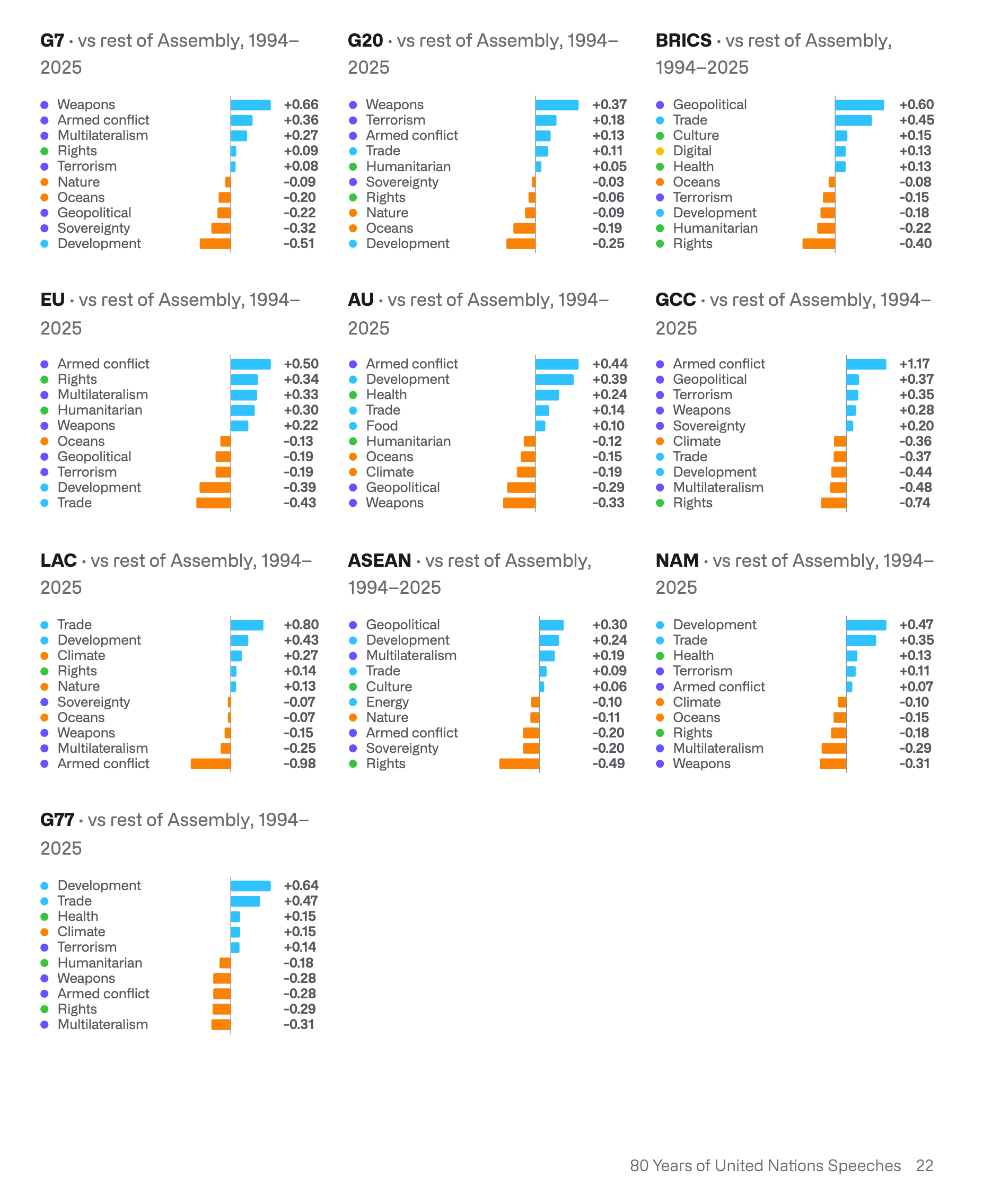
Cumulative score differences against the rest of the hall, theme by theme: the five subjects each bloc raises furthest above the Assembly's own level, and the five it raises furthest below.
GCC — the Gulf Cooperation Council
The GCC's members resemble one another more closely than any other group's do, and their largest single departure is the largest in the whole set: armed conflict at 1.17 above the line, more than twice as far as the next group's leading subject. Geopolitical order, terrorism, weapons and sovereignty follow, all of them above average. Human rights, at 0.74 below, is the largest negative recorded by any group on any subject, with multilateralism at 0.48 below behind it.
Latin America and the Caribbean
Latin America and the Caribbean is the GCC inverted. Trade at 0.80 above the line is the largest lead of any group on any subject, with development at 0.43 behind it, while armed conflict at 0.98 below is its largest gap and the second largest negative in the set. The region that says least about fighting says most about the terms of trade. It is also the only group whose members sound slightly less alike than the Assembly average, which is what a regional list rather than an alliance produces.
ASEAN — the Association of Southeast Asian Nations
ASEAN talks more than average about world order at 0.30 and development at 0.24, and considerably less about human rights at 0.49 below. That gap is the clearest example in the set of a signature produced by a stated rule rather than by a shared opinion: the association works by consensus and holds to a principle of not commenting on members' internal affairs, so the members are not disagreeing about rights so much as declining to raise them.
NAM — the Non-Aligned Movement
The Non-Aligned Movement places development at 0.47 above the line and trade at 0.35, with weapons at 0.31 below and the United Nations itself at 0.29 below. Its shape is the G77's, a little fainter at every position, which is unsurprising given that most countries belong to both and the movement has no membership treaty to sharpen the roster.
G77 — the Group of 77
Development at 0.64 above the line is the G77's largest lead of any group in the set, with trade at 0.47 behind it. It talks less than average about the United Nations at 0.31 below and about human rights at 0.29 below, which is worth stating plainly given that the G77 is a creature of the United Nations itself and was formed inside it in 1964.
Put side by side, the ten groups split cleanly in two. Five talk more than average about force and world order and five talk more than average about development and trade, and not one talks more about both. The split does not follow wealth, region or treaty status: the G7 and the GCC sit on the same side of it, as do the African Union and Latin America. Two qualifications apply. The membership lists for the Non-Aligned Movement and the G77 are approximate, and every figure in the set covers 1994 to 2025, so nothing here describes the Cold War chamber. The report draws no conclusion from the split beyond recording it: a group's signature reflects what its members find it useful to say at this podium, and that is not the same as what they do elsewhere.
Indices
Sixteen measures, four families, and how to read a stacked column.
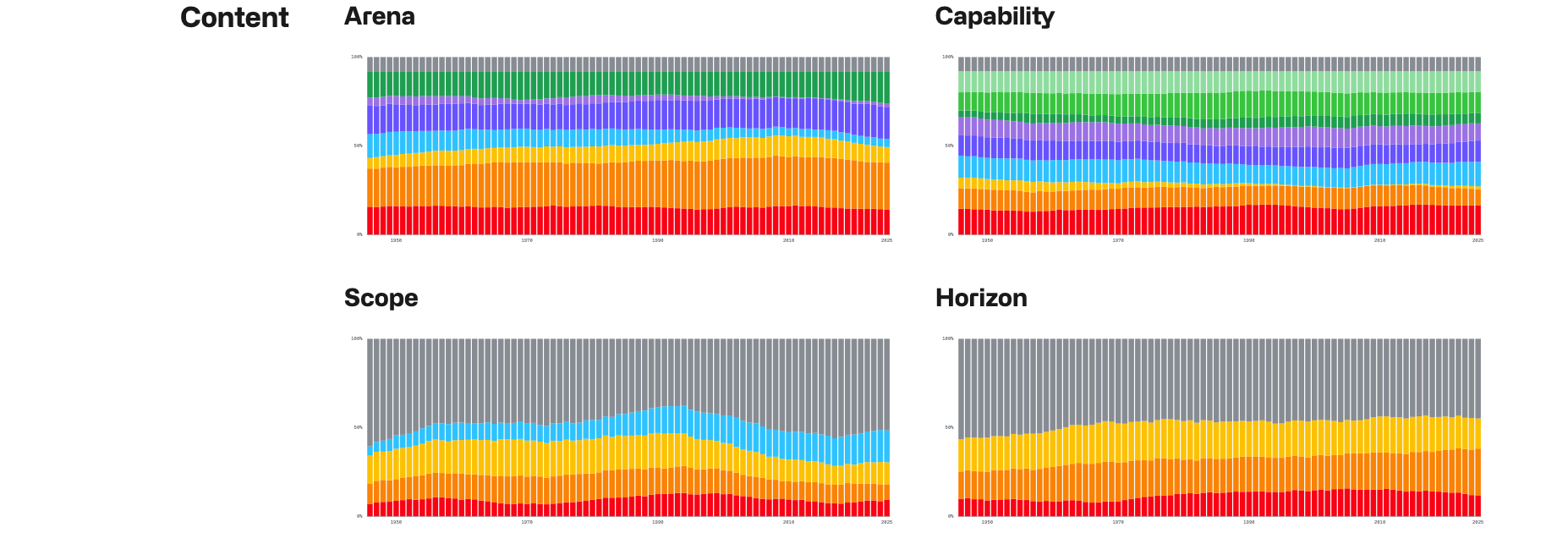
Every speech in this report has been read sentence by sentence, and every sentence tagged in twelve ways. Four further measures are computed for each speech as a whole. Together these sixteen measures constitute the indices, and the page that follows shows all sixteen at once, one chart each, across 80 years of the General Debate.
An index is a question asked of every sentence with a fixed list of answers. Arena, for example, asks what part of national life a sentence is about, and the answers are geopolitical, economic, social, technological, environmental, institutional or ceremonial. Each sentence takes one answer. Where none fits, the sentence is tagged Null, and Null is shown on the chart like any other answer so that nothing is concealed.
Because every sentence is tagged, a speech can be summarised as shares adding to 100 per cent, and a year is the average of the speeches given that year, each counting equally whatever its length. Each index is then reported twice, once as that composition of attention and once as each answer's own share of speeches, so that a rise in one answer can be distinguished from a fall in the rest.
The sixteen sit in four families of four. Content and Actors describe the world the speaker builds; Style and Prose describe the speaker's craft. The four Prose indices differ from the other twelve in that they are calculated by formula for the whole speech rather than tagged sentence by sentence, and they return a score rather than a share, so their charts show a spread rather than a stacked column.
Two qualifications apply throughout. The indices measure words rather than deeds: a promise counted here is a promise made, not a promise kept. And an average across the world's leaders conceals how far those leaders disagree. The Indices section takes each measure in turn and reports how the spread between speakers has widened or narrowed.
Figure 1.10 — The Content Dimensions
The Remaining Index Dimensions
Actors, style and prose at a glance.
Figure 1.11 — The Remaining Index Dimensions


