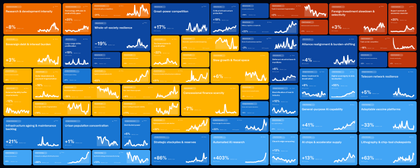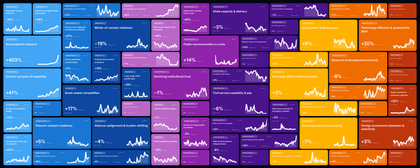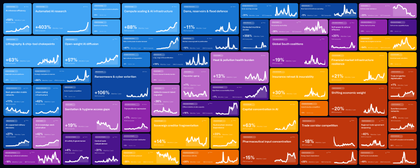

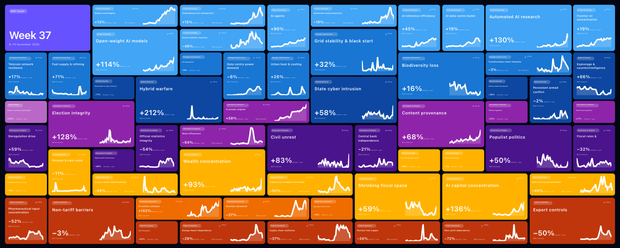
- Nvidia's resignation sent attention to chips and spies, not to concentration. AI chip supply rose 23 per cent and espionage 20, while market concentration and export controls did not move.
- Hybrid warfare rose again, and this week it was Italy. Hybrid warfare is up 18 per cent and 113 per cent over the month. Grid stability had the largest rise, up 24 per cent on Colombia.
- Expectations moved where attention did not: the chance of wider export controls rose from 42 to 46 per cent and of tighter chip supply from 59 to 66, while the chance that money keeps concentrating in AI fell from 63 to 57.
Week 46 In Brief
Attention this week went to the chips and the spies, not to the concentration behind them. Jensen Huang's resignation from Nvidia on 12 November lifted AI chip supply and espionage by about a fifth each, while market concentration and export controls stayed where they were. Hybrid warfare rose again, this time on Italy, where the same hoax bomb threat reached about 6,300 schools. Colombia's power warnings gave grid stability the week's largest rise. The second-largest Ebola outbreak on record moved nothing: infectious disease threats rose 1 per cent and is 30 per cent lower than a year ago.
Attention Index
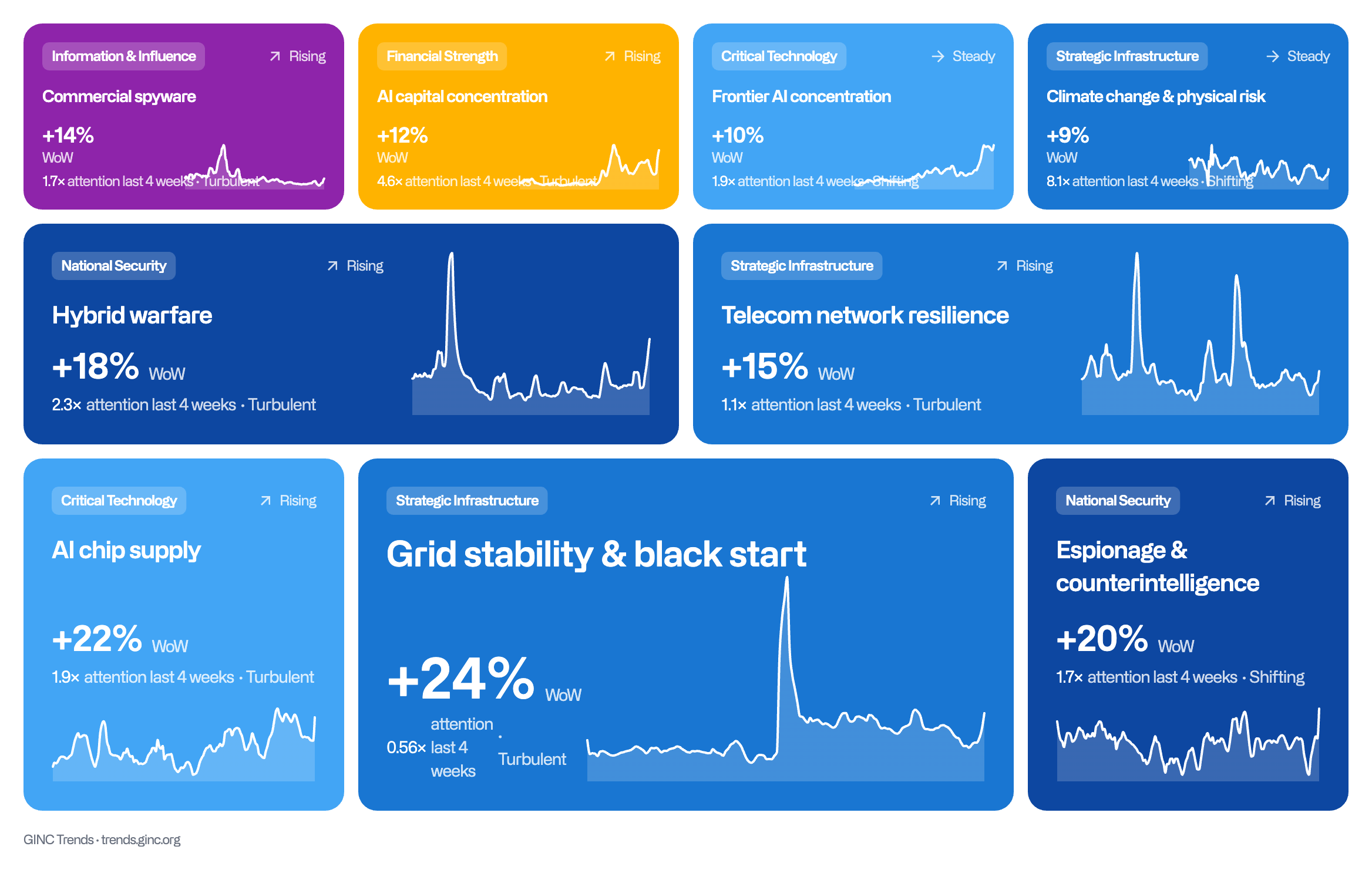
AI chip supply, up 23 per cent, and espionage, up 20. Jensen Huang left as Nvidia's chief executive and board member with immediate effect on 12 November (SEC filing), after reports of affairs, one with a Chinese businesswoman at a partner firm suspected of helping China obtain restricted chips (Taipei Times). Senate Majority Leader John Thune put 'a high probability' on tighter chip controls (Semafor). AI chip supply rose from 155 to 190 and espionage from 144 to 172. The concentration trends did not follow. Market concentration fell 2 per cent to 28, about a quarter of the typical trend, and export controls was flat at 23, 46 per cent lower than a year ago. The story reached the public as a scandal about a person and a product, not as a dependence on one firm. The resignation came on a Thursday, so the four-week average holds only part of it.
Hybrid warfare, up 18 per cent, and 113 per cent over the month. The index rose from 196 to 232, and this week's rise was Italian. The hoax bomb email first sent to 271 Italian schools on 2 November went to about 6,300 on 11 November (ANSA, Quotidiano Nazionale). In Italy the index more than doubled to 25 times the typical trend, and searches there were the highest in three years. Outside Italy the week was slightly quieter than the week of the flight hoaxes, and the four-week average rose in part because a quiet week in mid-October left it. Attribution is unsettled: the first email was signed as Iran's Revolutionary Guard and the second with a Russian name, and no state has been formally blamed (Foreign Policy). France separately blamed a Revolutionary Guard cyber unit for attacks that overheated supermarket freezers (NBC News). State cyber intrusion rose 8 per cent, while foreign information manipulation fell 16: the hoaxes are being read as a security story, not an information one.
Grid stability, up 24 per cent, the largest rise, from a low base. The index rose from 45 to 56. The rise was in Colombia, where attention rose sixfold and searches reached a three-year high. The grid operator warned on 14 November of an energy shortfall by March 2027 (El Heraldo), the Caribbean coast is already under load-shedding, and cable explosions cut power in parts of Bogotá on 11 and 12 November (Infobae). US attention has also climbed for four weeks, with no single cause found.
Commercial spyware, up 14 per cent, after 30 last week. The rise that began with Apple's warning to iPhone users in 99 countries continued, now outside Europe: Egypt rose 172 per cent and Morocco 170. The index rose from 150 to 171, up 61 per cent over the month.
AI capital concentration, up 12 per cent, after 20 last week. The index now stands at 461, up 152 per cent over the month. Frontier AI concentration rose 11 per cent. Attention is on the money in AI, not on the supply chain beneath it: supplier concentration stands at 7, third from the bottom of the 250 trends.
Ebola is not registering. The outbreak in the DRC and Uganda passed 11,000 cases and 5,387 deaths (Al Jazeera). Infectious disease threats rose 1 per cent, humanitarian system strain and aid and climate finance retreat each fell 1, and health workforce shortage is second from the bottom of the 250. All four are lower than a year ago.
Also moving. Telecom network resilience rose 15 per cent after the FAA halted departures at every US airport for about four hours on 13 November, first calling it a 'temporary telecommunications outage' (NPR). US searches doubled in the week. Weakening multilateralism fell 18 per cent, from 613 to 503. Carbon pricing fell 17 per cent during the COP31 leaders' summit, while climate change rose 9. Strategic stockpiles fell 16 per cent and contested maritime access 7, with the Strait of Hormuz still shut. The top five are the same trends: Global South coalitions at 19 times the typical trend, deepfakes 14, immigration enforcement 13, up to third, private military forces 13 and corruption 10.
Expectations Index
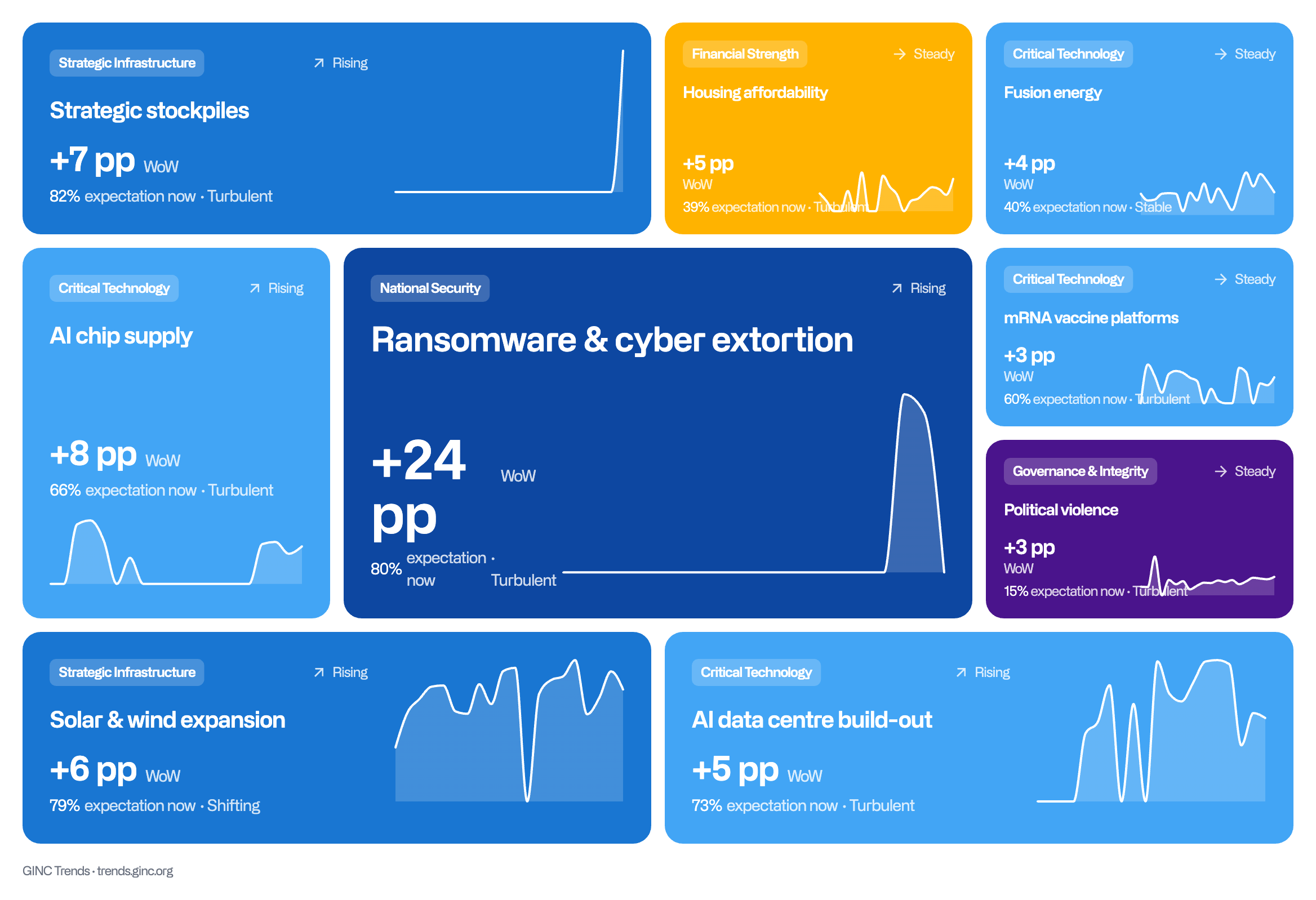
The Expectations Index looks ahead: for each trend it gives the chance, from 0 to 100 per cent, that it gets stronger over the coming months. This week it expects tighter chip supply and wider controls, and less money concentrating in AI.
Chips: tighter supply and more controls. The chance that AI chip supply tightens rose from 59 to 66 per cent in the week. The chance that export controls widen rose from 42 to 46 per cent. Expectations moved on export controls in the week public attention did not.
AI money: less concentration expected. The chance that AI capital concentration grows fell from 63 to 57 per cent, and from 75 four weeks ago, while attention to it rose 152 per cent over the month. The chance that asset valuations stay stretched is unchanged at 79 per cent.
Europe's security stories and Ebola: not expected to grow. Hybrid warfare is at 16 per cent, against attention that has more than doubled in a month. Espionage and commercial spyware have too few questions to publish. Infectious disease threats is at 9 per cent, down from 13 three months ago: expectations and attention agree, and both run against the case count.
Stockpiles and ransomware rose most. The chance that governments build up strategic stockpiles rose from 72 to 82 per cent, and from 43 four weeks ago, while attention to it fell. Ransomware rose from 61 to 80 per cent, on only two questions.
The post-midterm cooling continued. Wealth concentration fell from 27 to 21 per cent, executive overreach from 25 to 21 and civil unrest from 17 to 8. Commodity price swings fell from 33 to 26 per cent as oil stayed low.
Least likely to grow. Energy import dependence at 3 per cent, trade corridor competition at 4 and population ageing at 5.
Check out last week's GINC Trends Index for more context and subscribe to the weekly newsletter.