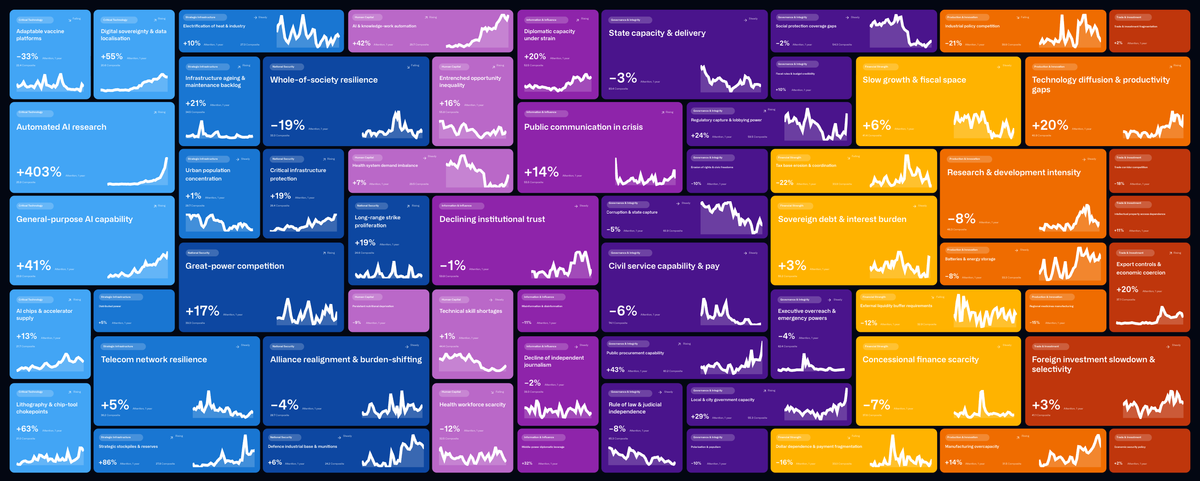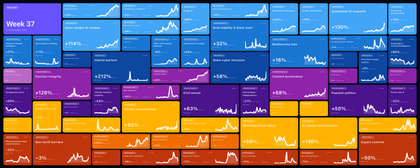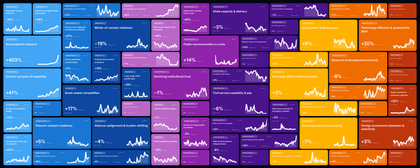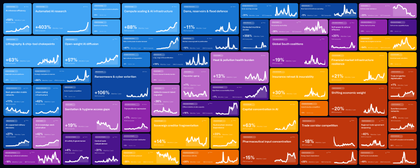

- US midterms and the AI sell-off powered the week, lifting wealth concentration, AI capital concentration and stretched asset valuations.
- European security rounded out the top five, with commercial spyware up 30% and hybrid warfare up 16%.
- Corresponding expectations dropped: political volatility is expected to fade, and AI funding flows to data centres and AI science rather than agents.
Week 45 In Brief
The United States dominated the index this week, driven by the midterms and the AI sell-off. Three of the five fastest-rising trends followed on in wealth concentration, AI capital concentration and stretched asset valuations. The other two are European security stories in commercial spyware and hybrid warfare. Interestingly, the Expectations Index fell on wealth concentration and executive overreach while attention to both rose.
Attention Index
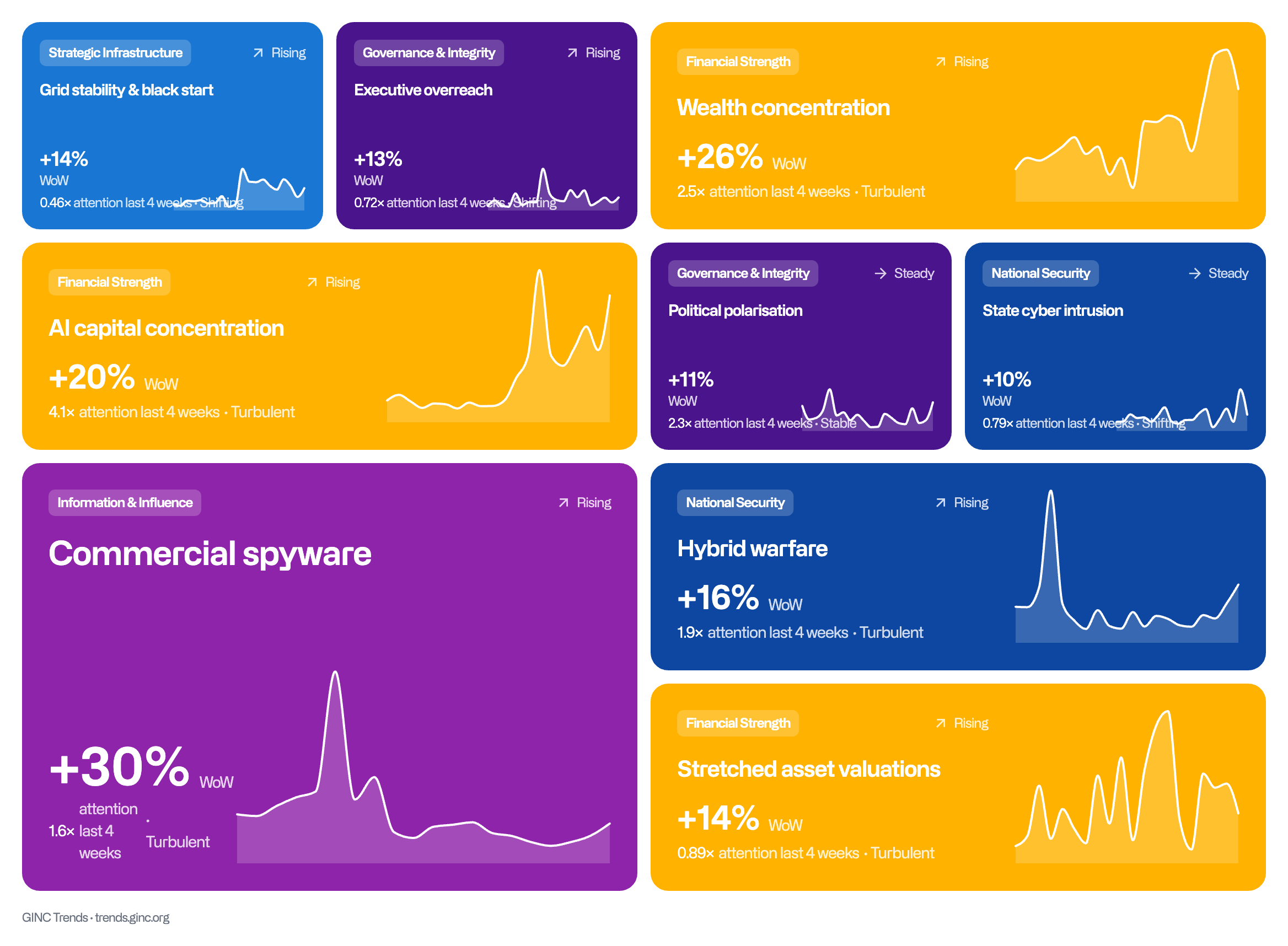
Commercial spyware was the largest driver, up 30%. Apple warned iPhone users in 99 countries of mercenary spyware (Techcrunch), Germany confirmed that Bundestag members and ministers were among them; the attacker unknown (Euronews). The rise came from the UK, up 138%, and the US, up 40%, but not from Germany, where the trend already stands at eleven times typical trend levels.
Wealth concentration, up 26% rising from 212 to 246; in the US it nearly doubled. California voted on Proposition 40, the first US billionaire tax. It was previously failing 54 to 46 on partial returns after billionaires gave $333 million against it (The Hill). Elon Musk lost about $113 billion in two days, and Bill Gates backed a wealth tax (Fortune).
AI capital concentration, up 20%, after 67% last week. Anthropic's IPO valuation expected to fall to $1.1-1.3 trillion from ~$1.5 trillion after the sell-off (Bloomberg). OpenAI lowered its own to ~$1.25 trillion, and Ramp data showed company AI spending flattening (TechCrunch). The index rose from 344 to 407, now the 25th highest of the 250. India rose 33 per cent, the UK 25, France 24.
Hybrid warfare, up 16%, and 82% over the month. The UK's National Cyber Security Centre, part of GCHQ, published its Annual Review: 1,831 incidents in the year to August, 80 nationally significant (techUK). Its chief, Richard Horne, warned of "an unprecedented rise in the number of cyber incidents" ahead. The report identified Russia for sustained attacks on military networks below the threshold of war, Iran for operations against individuals in the UK, and China as the most serious threat, "highly likely" to turn AI on critical infrastructure (NCSC). On 5 November hoax bomb threats hit at least 12 European flights, officials suspect Russia (Foreign Policy). Poland ran a border operation at Kaliningrad, and US European Command began a vigilance campaign (Military Times). State cyber intrusion rose 10 per cent.
Stretched asset valuations, up 14%. The Nasdaq 100 fell 6.3% and the S&P 500 4.4% on 5 November, the worst day since April 2025, on weak Qualcomm and Arm results, the election and AI bubble fears (NBC News). Ten AI-linked companies account for over half the S&P 500's gain since ChatGPT (Bloomberg). The index rose from 79 to 89. The US rose 24%, Taiwan 144%.
Also moving. Executive overreach rose 13%, political polarisation 11%, nuclear proliferation 10%. Weakening multilateralism fell 20% as the UN anniversary passed but stayed in the top ten. Ransomware fell 17% and has halved over the month. The top five remain unchanged: Global South coalitions at 20x the typical trend, deepfakes 14x, private military forces 13x, immigration enforcement 13x, corruption 10x.
Expectations Index
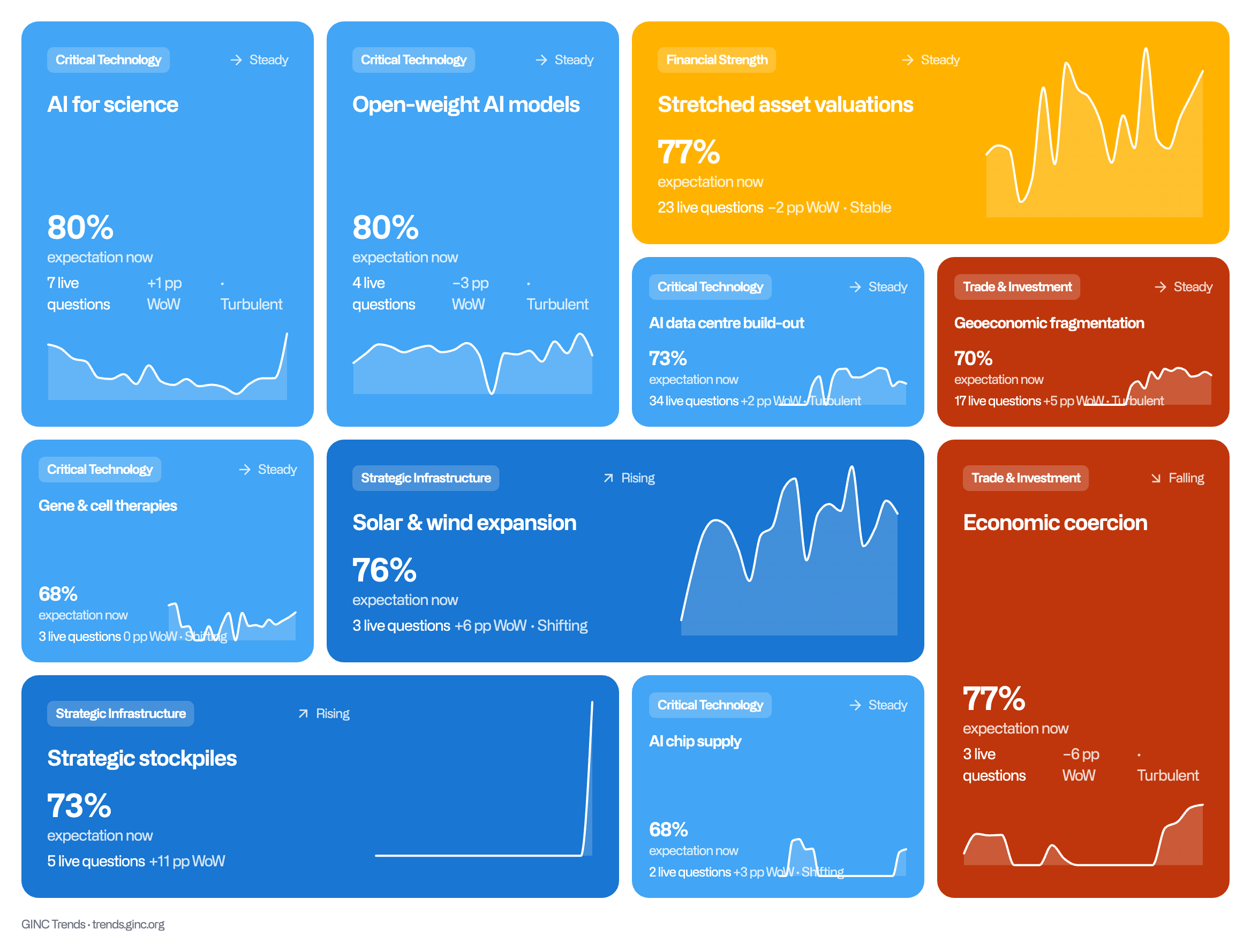
The Expectations Index looks ahead and this week suggests that the political anger behind the midterms is not expected to last, and that the funding for AI is expected to go into data centres and science, not AI agents.
Wealth and emergency powers: a lot of attention, but not expected to grow. The expectation that wealth concentration gets worse has fallen from 47% to 27% in four weeks. The expectation that executive overreach grows has fallen from 46% to 28%. Both were in the news all week, yet the index expects California's vote and the midterms to hold both back.
The stock market fall was not a surprise. The expectation that asset valuations stay stretched is 77%, one of the highest in the index, and it did not change in the week shares fell. In simple terms, the fall was expected. The expectation that AI capital concentration grows is 58%, down from 66% a month ago, after Anthropic's valuation has likely fallen in line.
AI data centres and science: yes. AI agents: no. The expectation that AI for science grows is 80%, the highest of any trend. Open-weight AI models are also at 80% and AI data centre build-out at 73%. The expectation that AI agents take off has fallen from 44% to 17% in four weeks. AI job displacement is also at 17%: the expectation index does not expect AI to take many jobs soon.
Supply shocks are the fastest-growing concern. Over the past three months the chance of commodity price swings has risen by 44 points to 30%, and of shipping lanes being contested from 14% to 45%. The expectation that governments build up stockpiles has risen from 35% to 73% in four weeks. Undersea cables and pipelines rose fastest of all, by 61 points to 11%.
Government bonds look safer than a month ago. The expectation of strain in government bond markets fell from 51% to 29% in four weeks as borrowing costs eased.
Least likely to grow. Energy import dependence at 3%, trade corridor competition at 5%, and immigration enforcement at 6%. Immigration enforcement is the fourth most-watched trend in the world, but the index does not expect it to extend further.
Check out last week's GINC Trend Index for more context and subscribe the weekly newsletter
 Patrick Brothers