


Patrick here and welcome to the third edition of 'The Shift'. Every Sunday, I'm sharing my personal notes on the major shifts playing out around the world and how they are shaping national strategy and long-term power, prosperity and resilience.
Alongside the major developments of the week, I'll be drawing on our emerging datasets, most notably our Global Shifts and the GINC Trends Index. We'll bring more data-driven insights together each week from a broader range of datasets and indices as time goes by.
Week in Brief
This week's main developments shared a common feature: risk moved outward while control stayed inward. Anthropic raised over US$80 billion in a mega-IPO, against about US$900 billion of commitments in the prospectus. Nvidia disclosed nearly US$120 billion of guarantees on other companies' obligations. Investors, suppliers and creditors now carry much of the cost of the AI build. The same listing sold ~7 per cent of the company and left 50.1 per cent of the votes with a single founders' class share. In Shenzhen, the US, Chinese and Russian leaders issued a declaration with no dates and no mention of Ukraine or Iran, and hours later Russia fired more than 400 drones and 110 missiles at Ukraine. In each case those bearing the cost had little say over the decision. Governments that depend on privately financed AI capacity, or on declarations by larger powers, are relying on decisions they do not control.
Technology turning from asset-light to capital-heavy
Technology's accelerated turn from asset-light to capital-heavy was front and centre this week. Software companies that needed little physical capital have become builders of the world's largest infrastructure. National AI capacity now rests on terms set by bond and equity markets, as the burden of funding the energy and compute infrastructure shifts from private to public capital markets.
Anthropic's listing highlights the scale: its offering on 18 November sold US$81.3 billion of shares. The prospectus lists about US$900 billion of commitments, nearly all for compute and infrastructure, with US$70 billion due within a year. Revenue for the nine months to September was US$33.2 billion (SEC). Net proceeds cover about an eighth of the total, counting US$26 billion placed with seven chip and cloud companies.
Suppliers and creditors carry more of the risk. Nvidia's 17 November results put its guarantees of other companies' obligations at up to US$118 billion, mostly for one Ohio site leased to OpenAI (Nvidia). Fitch counts US$277 billion of hyperscaler bonds this year, against US$108 billion in 2025. Meta's notes due 2056 paid 0.9 percentage points more over Treasuries than its April issue (Fitch, via TNGlobal).
Equity investors marked the sector down. The Nasdaq 100 fell 10.4 per cent, its worst week since March 2020, and Nvidia lost about 23 per cent (Reuters).
The strongest objection to this shift is that the market provided the capital regardless. Anthropic priced above its marketed range and ended the week above its offer price. For governments, a compute strategy costed on 2025 financing terms is underfunded. Securities regulators should require purchase commitments and supplier guarantees to be disclosed as debt is.
World order turning from shared to contested
The world order is arguably continuing to move from a rules-based multilateral system to a contested, multipolar one. At their first summit, in Shenzhen on 19 November, the US, Chinese and Russian leaders issued a four-point declaration upholding state consent and officials' immunity. The summit set no date for a nuclear-risk dialogue and omitted Ukraine and Iran (China MFA).
Hours later Russia fired more than 400 drones and 110 missiles at Ukraine, by Kyiv's count (Al Jazeera). COP31 closed on 22 November with no agreement and no US delegation present (CBS News).
The contesting argument came the same day as the summit. The International Court of Justice found Myanmar responsible for genocide against the Rohingya, its first such finding against a state (UN News). Enforcement falls to the Security Council, where all three summit powers hold a veto. I suspect lawyers will cite this judgment for decades, but no government is likely to enforce it.
Ownership narrowing from broad to concentrated
In more and more cases, ownership of assets is narrowing from many holders to very few, and Anthropic's listing (much like SpaceX's) shows how little a public sale spreads it. The 980 million shares sold are about 7 per cent of the company. One share, held by the founders' vehicle, carries 50.1 per cent of the votes, and a trust elects most of the board. Such structures are becoming common: 41.1 per cent of US IPOs in 2025 had dual-class shares, against 13.8 per cent in 2005 (Ritter). Public markets are generally advertised as delivering better governance, on the basis that public means public control. In this case, the public share is very small and control remains with the founders. For a mega IPO that is understandable, since the valuation implies a market capitalisation far outpacing what capital markets could absorb. It is, however, a trend away from the public intent of public markets.
The counter-evidence is that the holding widened. Retail buyers received about 15 per cent of the offering, which Bloomberg counts as the biggest in history (Bloomberg). That is, however, just over 1 per cent of the company.
I think public markets were designed for mass holding as a form of governance. This listing gives many savers the exposure and almost none of the control.
GINC Trends Index. Week 47, 2026
 Patrick Brothers
Attention Index
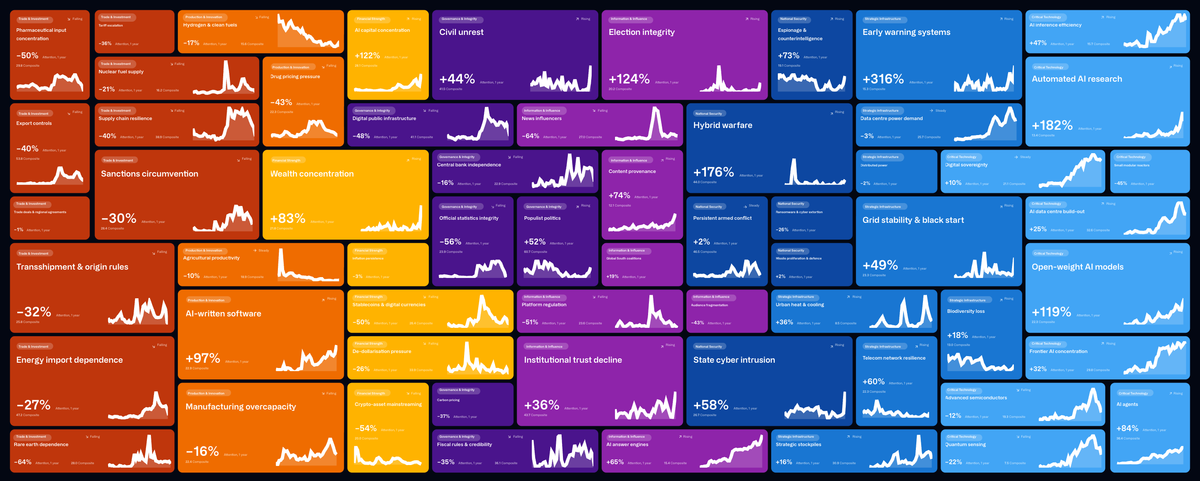
- Early warning systems: up 80 per cent, the week’s largest rise, from 123 to 221 after alert tests in the US, Canada and South Korea in three days. South Korean searches rose to about 47 times their usual level.
- Grid stability: up 25 per cent to 69, a fifth weekly rise and 99 per cent over the month, on Ukraine’s all-day power cuts and blackout hoaxes in the US and UK.
- Stretched asset valuations: the index went from 88 to 98 as Nvidia’s record quarter and Anthropic’s $81 billion listing failed to steady the AI trade. Attention is still 36 per cent lower than a year ago.
- Alliance burden-shifting: up 11 per cent to 121 as the US reviews its troop levels in Europe, 31 per cent higher than a year ago.
- Chips and espionage: AI chip supply went from 194 to 213, up 38 per cent over the month, after the US required licences for chips bound for five countries. Espionage rose 6 per cent and export controls 3 per cent.
- Telecom network resilience: up 8 per cent, after 15 last week, on six days of separate US system failures.
Expectations Index
- AI money: odds for stretched asset valuations fell 1.8 points to 62 per cent and for AI capital concentration 1.2 to 83, even as attention to both rose.
- Chips and frontier AI: AI chip supply and frontier AI capability both rose to 89 per cent, with data centre build-out at 87 and export controls flat at 91.
- Strategic stockpiles: up 1.8 points to 81 per cent, the largest rise, and 12 points over four weeks, on only four questions.
- Post-midterm cooling: wealth concentration, executive overreach and election integrity each fell 1.1 points. Commodity price swings fell 1.2 to 87 and gold reserve accumulation 1.4 to 83.


