


Welcome to the second edition of ‘The Shift’. Every Sunday, I share my personal notes on the major shifts playing out around the world and how they are shaping the future of national capability and long-term power, prosperity and resilience.
Alongside the week’s major developments, I'll draw on the datasets we are building, most notably the GINC Trends Index, which tracks 250 trends and the weekly changes in attention and expectations around each of them, across 14 languages. Over time, we will bring in data-driven insights from a broader range of datasets and indices.
Week in Brief
This week’s major developments shared the same underlying pattern: systems that appeared robust turned out to rest on single points of failure, each hiding in plain sight. Jensen Huang’s sudden exit from Nvidia shone a spotlight on four layers of concentration risk, in leadership, compute, advanced manufacturing and capital, as well as a governance failure by both the board and the state. A wave of hoax bomb threats across Europe demonstrated how cheaply an attacker can impose costs where there is no consensus on attribution. And the Ebola outbreak in the DRC and Uganda, now the second-largest on record, is testing an emergency system with no funding trigger. In each case the basics were left unattended while times were good. With most of the world’s governments highly leveraged, and little governance or management of concentration risk, the global economy has normalised ‘just in time’ responses to shocks that we lack the financial capacity to absorb.
Critical Technology
Jensen Huang resigned as Nvidia’s chief executive and board member with immediate effect on 12 November (SEC filing). Colette Kress, the chief financial officer, is interim chief executive, and shares in Nvidia fell significantly. All eyes will be on Nvidia’s results, scheduled for 17 November.
The dramatic week exposes four layers of concentration stacked on top of one another, and is a reminder of how central Nvidia is to both the upside and downside scenarios for AI. Jensen Huang ran the firm for more than 30 years, most recently with up to 60 direct reports. The firm supplies more than 90 per cent of the world’s advanced AI chips, and TSMC manufactures almost all of them. Nvidia also sits at the centre of the circular financing that underpins AI, and is often referred to as the ‘central bank of AI’.
Beyond concentration risk, this is a governance failure twice over. The first failure is the board’s. The resignation followed reports of affairs, one with a Chinese businesswoman at a partner firm suspected of helping China obtain restricted chips. The spy claim is an allegation. Even so, an immediate exit and an interim replacement read to many as a board with no succession plan for the one person the firm, and perhaps the AI economy, could least afford to lose.
The second failure is the state’s. Governments have built national AI strategies and data centre programmes on Nvidia’s supply, yet none appears to have examined how the firm is governed. Washington is now reacting after the event: Senate Majority Leader John Thune puts ‘a high probability’ on tighter chip export controls (Semafor).
There are two implications for governments and boards. First, counter-intelligence needs to cover people as well as chip designs and export controls, because a personal relationship proved the cheapest route into the supply chain. Second, key-person risk at strategic firms is now a national risk, and governments are likely to begin vetting the executives who run them.
National Security
Hoax bomb threats hit at least 27 European flights on 5 November and about 6,300 Italian schools, plus hundreds in the UK and Ireland, on 11–12 November. No one has been formally blamed. Separately, France attributed cyber attacks that overheated supermarket freezers to an Iranian Revolutionary Guard unit.
The economics favour the attacker. A hoax email costs nothing, while fighter escorts and school evacuations are expensive, and governments cannot afford either to respond every time or to ignore a threat that may be real. Targeting schools also shifts the pressure from infrastructure to public trust in government.
Attribution is the main constraint on a response. European leaders, notably Meloni and Macron, do not agree on who is responsible, and without an agreed standard for assigning blame no collective response can be triggered. Firms have their own reason to avoid attribution, because cyber insurance often excludes state-backed attacks.
Two further risks stand out. Building controls and cold chains are not classed as critical infrastructure, so they are largely unregulated. And if Iran is behind the freezer attack, the Hormuz confrontation has reached Europe through low-cost retaliation.
Human Capital
The Ebola outbreak in the Democratic Republic of the Congo (DRC) and Uganda has passed 11,000 cases and 5,387 deaths, making it the second-largest on record. The strain has no vaccine or treatment. US aid cuts and the US exit from the World Health Organization (WHO) have weakened the response, and the WHO’s emergency fund is close to empty.
The emergency system is not built to escalate. The declaration is six months old and carries no funding trigger, so attention has faded while cases have grown. The true count is probably higher, because surveillance was funded from the budgets that were cut. Rich countries have shifted from containing the outbreak at source to screening at their own borders.
Three longer-term issues follow. Vaccine platforms were built for the common strain, so this outbreak will test whether adaptable ones can deliver in time, and who pays for them. It is the first major outbreak since the US withdrew, and whoever fills the gap will set the model for the next one. Deaths among health workers will also set back routine care for years.
GINC Trends Index. Week 46, 2026
 Patrick Brothers
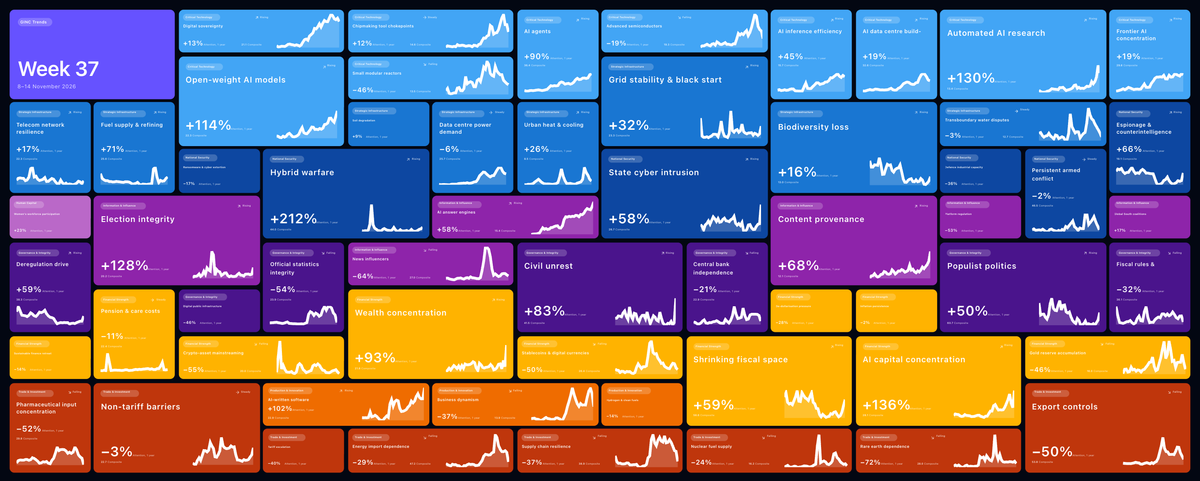
Nvidia's resignation pushed attention towards chips and spies and away from concentration. Hybrid warfare kept rising, this week on Italy, and the Ebola outbreak moved nothing.
Attention Index
- Chips and espionage: AI chip supply went from 155 to 190 and espionage from 144 to 172 after Jensen Huang's exit. Market concentration slipped 2 per cent to 28 and export controls sat flat at 23.
- Hybrid warfare: the index climbed from 196 to 232, up 18 per cent on the week and 113 per cent over the month. Italy more than doubled to 25 times the typical trend after hoax bomb emails reached about 6,300 schools.
- Grid stability: up 24 per cent, the week's largest rise, with Colombian attention up sixfold on shortfall warnings and power cuts.
- Commercial spyware: up 14 per cent, now spreading beyond Europe, with Egypt and Morocco each up about 170 per cent.
- AI capital concentration: up 12 per cent to 461, 152 per cent higher over the month.
Expectations Index
- Chips: odds of tighter chip supply moved from 59 to 66 per cent, and of wider export controls from 42 to 46.
- AI money: odds that AI capital concentration grows dropped from 63 to 57 per cent, against 75 four weeks ago.
- Security and Ebola: hybrid warfare is rated at just 16 per cent and infectious disease threats at 9.
- Biggest risers: stockpile-building odds went from 72 to 82 per cent and ransomware from 61 to 80, the latter on only two questions.
- Post-midterm cooling: wealth concentration, executive overreach and civil unrest all declined.


