


- X
- Y
- Z
Washington has shown it can still correct, but a 54–44 Senate after a 53–47 one is oscillation, not stability. US voters handed Democrats both chambers of Congress this week, flipping seven Senate seats including Texas and Kansas; the president kept his veto, accepted the result on the night and losing Republicans conceded. The optimist sees a broad, persuadable electorate rather than a permanently sorted one, and a Congress that will fund allies and constrain unilateral war. The pessimist sees policy made by executive order and undone two years later, which allies and investors cannot plan against. The structural lines on GINC Trends (Global South coalitions first for ten straight weeks, Weakening multilateralism eighth) were set before Tuesday, and hegemony that withdraws from the Gulf by appropriation is hegemony in retreat, whatever the vote says about institutions.
The Gulf is pricing a peace it has not got. Oil fell nearly 20 per cent to below US$100 on the midterm result and Schumer's declaration that the war 'must end', in the same week as more ship attacks and an Omani proposal for joint Iran–Oman control of Hormuz traffic. The optimist's reading is that a cash-starved regime without a Supreme Leader can be bought into a verifiable nuclear freeze, and a Democratic Congress gives Trump the exit. The pessimist's is that Iran's conditions are unchanged since September, a state struck by surprise wants a deterrent, and 'stability' on Oman's terms is a toll booth with a navy. The market priced peace in June too, and that ceasefire lasted three weeks. Israel, meanwhile, certified an election with no winner: Netanyahu's bloc 53, opposition 48 and Arab-led parties a historic 19 holding the balance. That is either the most significant democratic shift in Israel in a generation or the prelude to a fourth election under a caretaker with every incentive to escalate, and now less American money to do it with.
London has named the horizon, and it is a chronic condition rather than a managed risk. The National Cyber Security Centre's tenth annual review counted 1,831 attacks in ten months, 80 of them nationally significant, and its assessment of AI and cyber threat projects a 2028 in which AI coordinates compromise reaching robots and cloud-controlled infrastructure, while a commercial intrusion market lets states buy capability off the shelf. Its calmer judgement is the useful one: AI makes attacks faster and more common rather than new, defenders know what to do, and frontier models such as Gemini 4 Carbon now ship to defenders first. But the week's unattributed bomb threats against European aviation needed no AI at all, only a phone and a jurisdiction that cannot trace it.
GINC Trends Index. Week 35, 2026
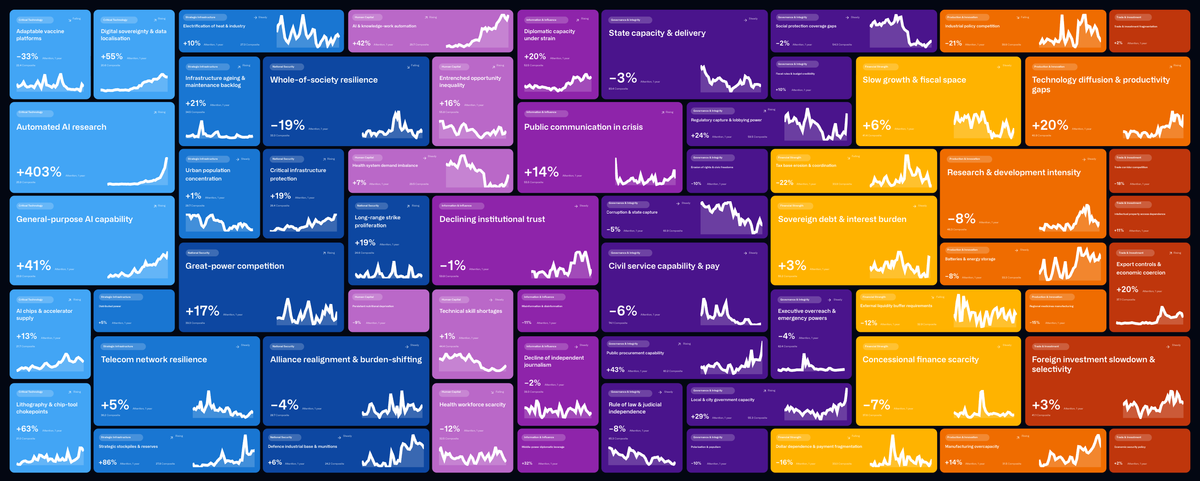
The United States dominated the GINC Attention Index this week, with the midterms and the AI sell-off driving three of the five fastest-rising trends: wealth concentration (up 26 per cent, nearly doubling in the US as California voted on Proposition 40 and Musk lost $113 billion in two days), AI capital concentration (up 20 per cent after Anthropic and OpenAI cut their valuations and company AI spending flattened) and stretched asset valuations (up 14 per cent after the Nasdaq 100's worst day since April 2025). The other two risers were European security stories: commercial spyware, the largest mover at 30 per cent after Apple warned users in 99 countries and Germany confirmed Bundestag members were targeted, and hybrid warfare, up 16 per cent on the NCSC Annual Review and suspected Russian bomb hoaxes against European flights. The top five remain unchanged, led by Global South coalitions at 20 times typical levels.
The Expectations Index points the other way on the week's loudest stories. The chance that wealth concentration or executive overreach worsens has roughly halved in four weeks, to 27 and 28 per cent, suggesting the index reads the midterms and California's vote as a brake rather than an accelerant. The market fall was priced in, with stretched valuations holding at 77 per cent. In AI, the money is expected to go to science, open-weight models and data centres (73–80 per cent), not agents or job displacement (both 17). The fastest-growing worry is supply shocks: contested shipping lanes have risen from 14 to 45 per cent and government stockpiling from 35 to 73. Government bonds look safer than a month ago, while the European security trends remain a blind spot the index cannot yet read.
 Patrick Brothers
Feature Insight
XXX
 GINC

Featured Index
xxx
 Patrick Brothers