
- Bullet
- Bullet
- Bullet
The week the streets came back
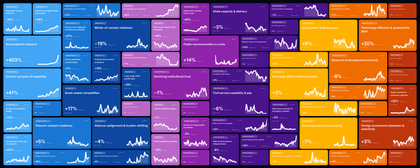
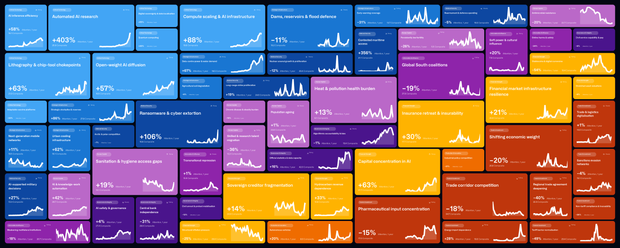
The week to 24 October belonged to the streets and the shadows. Attention to civil unrest more than doubled and attention to hybrid warfare almost did, while the quieter forces of public finance, sovereign wealth and fiscal room, drew more notice than at any point in the autumn. The typical trend in the GINC Trends attention index moved about seven per cent either way; a dozen moved by more than a fifth. Prediction markets, read through the GINC Trend Expectations Index, tell a different story from the headlines: traders are most confident about ransomware, chip chokepoints and stockpiling, and have been marking down the odds on AI agents even as attention to them climbs.
Attention: what people read and searched
Civil unrest, up 155 per cent. Attention to civil unrest rose from an index of 96 to 245 in a week, the largest move of any trend, after France's cost-of-living protests turned violent on the weekend of 17–18 October. Some 500,000 people are thought to have marched and about 2,000 were arrested in a night of arson and looting (Channel 4 News); the government followed with partial curfews in Paris and other cities (Khaleej Times). The spillover shows in a neighbouring trend: attention to executive overreach and emergency powers rose by half worldwide and more than tenfold in France, as the debate turned to a state of emergency. In the United States, searches on civil unrest more than tripled.
Hybrid warfare, up 84 per cent. Attention to hybrid and grey-zone coercion rose from 135 to 249. NATO's annual Hybrid Symposium in Bucharest on 15–16 October set the agenda, with allies, the EU and industry discussing sabotage, drone incidents and cyber attacks on energy infrastructure (NATO), and commentary through the week asked why Europe was failing to stop the campaign (Foreign Policy). The rise was broad rather than European: the equal-weighted world index rose almost ninefold, with South Korea and Colombia among the countries moving most. Attention to drone warfare rose a further 26 per cent on top of the previous week's gains.
Sovereign wealth and fiscal room, up 47 and 38 per cent. Two Financial Strength trends that rarely trouble the leaderboard both moved. Norway's $2.3 trillion fund reported a $30 billion third-quarter loss on 22 October as a global bond sell-off pushed up yields (Euronews), and attention to sovereign wealth funds rose from 171 to 252, with the United Arab Emirates and South Africa among the sharpest national rises. The IMF–World Bank Annual Meetings in Bangkok, which peaked on 16 October, left their mark the following week: the IMF's warning that heavy public debt and decades-high bond yields leave governments little room to absorb shocks (The Nation) coincided with a 38 per cent rise in attention to shrinking fiscal space and a 32 per cent rise in the cost-of-living squeeze.
On the way down, attention to weakening multilateralism fell 41 per cent and to missile proliferation and defence 34 per cent, both retreating from spikes the week before. Among the ten most-read trends, Global South coalitions kept first place at 19 times the typical trend, and misinformation and disinformation rose 18 per cent to re-enter the top ten.
Expectations: what the markets are pricing
The Trend Expectations Index is a prototype that reads Polymarket, Kalshi and Manifold for the market-implied chance that each force strengthens. It covers 104 of the 250 trends; a trend with no live questions has no reading. The figures below are the latest reading and the change over 13 weeks.
Commodities and sea lanes: the sharpest upgrades. The largest 13-week move anywhere in the index is commodity price volatility, up 45 percentage points, with contested maritime access up 29 points to a 43 per cent chance. Both sit downstream of the Middle East war that dominated the Bangkok meetings, and both are moving faster in the markets than in public attention, where neither trend ranks in the top 50.
AI agents: attention up, odds down. AI agents were the third most-read trend of the week, at nearly six times the typical trend, yet traders have cut the odds that the force strengthens as its questions describe by 30 points over the quarter, to 18 per cent. The same divergence appears in AI job displacement, down 15 points to 21 per cent. The opposite is true of AI for science, up 29 points to an 81 per cent chance, and of AI data centre build-out, which at 71 per cent carries the fourth-largest volume of money traded of any trend. The markets, in short, believe in the infrastructure and the science more than in the agents.
Executive overreach: the most-traded doubt. Executive overreach and emergency powers attracts one of the three largest pools of money on the platforms, behind only data centre power demand and inflation, and the odds have fallen 24 points to 19 per cent over the quarter. That it is also the trend whose attention rose fastest in France this week makes the gap worth watching: forecasters are betting against emergency government even as Paris debates it.
At the top of the table, the markets give ransomware and cyber extortion a 98 per cent chance of strengthening, chipmaking tool chokepoints 94 per cent and strategic stockpiles 93 per cent, each on a handful of questions. At the bottom sit energy import dependence at three per cent and conscription revival at six per cent, the latter on a deep pool of trading.
About these figures
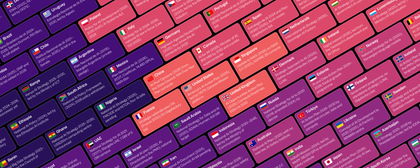
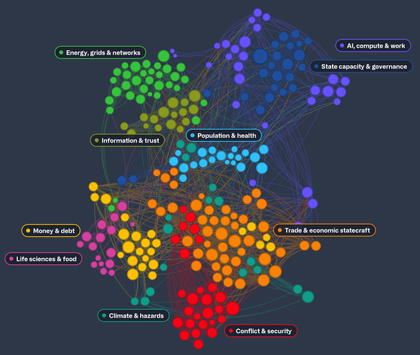
The GINC Trends attention index combines Wikipedia reading in 28 languages with Google search worldwide and in 49 countries. Each trend is measured against the median trend over the trailing 52 weeks, so 100 is the typical trend and a rise means a trend gained ground on the rest of the list. Weeks run Sunday to Saturday and are named by the Saturday they end; this brief covers the week ending 24 October 2026 against the week ending 17 October. Country figures start from small volumes in some places and can swing widely on little searching.
The Trend Expectations Index is a prototype and is read here as it stood on 31 October, with its 13-week change; a week-by-week series is not yet published. Its readings depend on which questions the platforms happen to list, and a trend with two live questions is a thinner reading than one with 30. Linking moves to events is a judgement made from timing; the data cannot prove the cause.
The full weekly attention data for all 250 trends is published openly at trends.ginc.org under a CC BY 4.0 licence.