National Security: 2026 National Capability Ratings
Nations on the Global Capability Frontier for National Security
- 🇮🇱 Israel and 🇺🇸 United States represent the only Tier 1 nations in National Security. Israel leads in Intelligence and Cyber capabilities, whilst the United States leads across Land, Maritime, Air, Space and Nuclear domains.
- 🇨🇳 China and 🇫🇷 France are the only Tier 2 nations in National Security. China follows the US in Maritime and Space, whilst France leads China in Air Power and Nuclear.
- Tier 3 comprises 🇮🇹 Italy, 🇯🇵 Japan, 🇰🇷 South Korea, 🇷🇺 Russia and 🇬🇧 United Kingdom.
From ancient empires to modern superpowers, the rise and decline of nations has been shaped by their ability to develop, project and sustain military and strategic capabilities across all domains of power.
National Security represents one of three hard capability domains within the National Capability Framework. This domain evaluates a nation's ability to defend sovereignty, project power and maintain strategic autonomy through advanced capabilities across seven National Security capability groups: Land, Maritime, Air, Space, Intelligence, Cyber and Nuclear. These capabilities underpin national power, prosperity and resilience, shaping military advantage, economic competitiveness and the capacity to withstand systemic shocks whilst determining freedom of action in an increasingly contested global environment.
Built on assessments of over 30 discrete capabilities, our ratings prioritise unit-level capability quality, the sophistication and effectiveness of individual defence systems, rather than aggregate force size or military expenditure. Being on the National Security Capability Frontier represents leadership in next-generation defence capability.
Figure 1 presents the top 20 nations ranked by National Security capability, using lexicographic ordering to privilege frontier leadership over average or weighted capability levels.
Figure 1. Top 20 Nations: National Security Capability Frontier
| National Security | Hard Capability | Soft Capability | Econ Capability | Frontiers | |||||||||
|---|---|---|---|---|---|---|---|---|---|---|---|---|---|
| Tier | Nation | CT | SI | NS | HC | II | GI | FS | PI | TI | T1 | T2 | T3 |
| T1 | 🇮🇱 Israel | T2 | T2 | T1 | T1 | T2 | T1 | T3 | T1 | T1 | 5 | 3 | 1 |
| T1 | 🇺🇸 United States | T1 | T1 | T1 | T1 | T1 | T3 | T1 | T1 | T1 | 8 | - | 1 |
| T2 | 🇨🇳 China | T2 | T1 | T2 | T3 | T2 | T4 | T3 | T2 | T2 | 1 | 5 | 2 |
| T2 | 🇫🇷 France | T3 | T2 | T2 | T4 | T2 | T5 | T1 | T3 | T3 | 1 | 3 | 3 |
| T3 | 🇮🇳 India | T6 | T4 | T3 | T9 | T3 | T9 | T5 | T6 | T7 | - | - | 2 |
| T3 | 🇮🇹 Italy | T5 | T4 | T3 | T7 | T4 | T7 | T5 | T6 | T5 | - | - | 1 |
| T3 | 🇯🇵 Japan | T3 | T1 | T3 | T4 | T1 | T3 | T2 | T2 | T2 | 2 | 3 | 3 |
| T3 | 🇷🇺 Russia | T5 | T3 | T3 | T8 | T6 | T10 | T10 | T12 | T11 | - | - | 2 |
| T3 | 🇰🇷 South Korea | T2 | T1 | T3 | T2 | T1 | T2 | T2 | T1 | T1 | 4 | 4 | 1 |
| T3 | 🇨🇭 Switzerland | T4 | T2 | T3 | T6 | T4 | T8 | T5 | T5 | T5 | - | 1 | 1 |
| T3 | 🇹🇷 Turkey | T6 | T5 | T3 | T8 | T4 | T10 | T7 | T8 | T8 | - | - | 1 |
| T3 | 🇬🇧 United Kingdom | T4 | T3 | T3 | T4 | T2 | T4 | T1 | T4 | T4 | 1 | 1 | 2 |
| T4 | 🇦🇺 Australia | T5 | T3 | T4 | T4 | T2 | T3 | T3 | T4 | T4 | - | 1 | 3 |
| T4 | 🇩🇪 Germany | T2 | T2 | T4 | T4 | T1 | T4 | T1 | T3 | T3 | 2 | 2 | 2 |
| T4 | 🇮🇷 Iran | T8 | T7 | T4 | T10 | T10 | T18 | T18 | T13 | T15 | - | - | - |
| T4 | 🇽🇰 Kosovo | T7 | T7 | T4 | T10 | T11 | T14 | T8 | T8 | T9 | - | - | - |
| T4 | 🇳🇱 Netherlands | T2 | T1 | T4 | T3 | T1 | T2 | T2 | T2 | T2 | 2 | 5 | 1 |
| T4 | 🇳🇴 Norway | T4 | T1 | T4 | T3 | T1 | T1 | T2 | T3 | T3 | 3 | 1 | 3 |
| T4 | 🇵🇰 Pakistan | T10 | T9 | T4 | T16 | T10 | T17 | T12 | T15 | T13 | - | - | - |
| T4 | 🇵🇱 Poland | T6 | T4 | T4 | T7 | T4 | T8 | T5 | T5 | T6 | - | - | - |
| T4 | 🇸🇦 Saudi Arabia | T6 | T2 | T4 | T5 | T3 | T6 | T3 | T5 | T5 | - | 1 | 2 |
| T4 | 🇸🇬 Singapore | T4 | T1 | T4 | T1 | T1 | T1 | T1 | T1 | T1 | 7 | - | - |
| T4 | 🇪🇸 Spain | T5 | T3 | T4 | T6 | T3 | T6 | T3 | T5 | T5 | - | - | 3 |
| T4 | 🇸🇪 Sweden | T2 | T1 | T4 | T2 | T1 | T1 | T1 | T1 | T2 | 5 | 3 | - |
| T4 | 🇦🇪 UAE | T5 | T1 | T4 | T4 | T1 | T2 | T2 | T2 | T2 | 2 | 4 | - |
Source. GINC Data Laboratory, February 2026
Overview
National Security Capabilities
National Assessments
Capability Groups
National Case Studies
Scenarios and Sensitivity Analysis
Data and Definitions
National Security
National Security is one of nine domains assessed within the National Capability Framework and one of three domains that comprise the Hard Power pillar. It aggregates 29 underlying capabilities, organised into seven capability groups, which together define a nation's national security capacity. GINC's National Security framework provides a standardised taxonomy that maps to published national definitions, enabling systematic comparison of security capabilities across diverse strategic approaches and policy frameworks.
Figure 1. National Security Capabilities by Capability Group
| Capability | Top 5 | Description |
|---|---|---|
| Land Power | ||
| Ground forces | 🇺🇸 🇮🇱 🇨🇳 🇫🇮 🇰🇷 | Infantry, mechanised and armoured ground combat units |
| Armour | 🇺🇸 🇮🇱 🇨🇳 🇰🇷 🇫🇷 | Main battle tanks and armoured fighting vehicles |
| Artillery | 🇮🇱 🇺🇸 🇨🇳 🇰🇷 🇫🇷 | Rocket systems, tube artillery and precision fires |
| Aviation | 🇺🇸 🇮🇱 🇨🇳 🇦🇪 🇸🇬 | Army aviation and rotary-wing aircraft |
| Logistics | 🇺🇸 🇮🇱 🇨🇳 🇰🇷 🇸🇬 | Combat service support and sustainment capabilities |
| Special operations | 🇺🇸 🇮🇱 🇬🇧 🇫🇷 🇸🇬 | Elite forces for unconventional warfare and precision strikes |
| Maritime Power | ||
| Naval surface combatants | 🇺🇸 🇨🇳 🇯🇵 🇰🇷 🇫🇷 | Destroyers, frigates and corvettes for surface warfare |
| Subsurface combatants | 🇺🇸 🇯🇵 🇨🇳 🇬🇧 🇫🇷 | Attack and ballistic missile submarines |
| Carriers | 🇺🇸 🇨🇳 🇬🇧 🇫🇷 🇮🇳 | Aircraft carriers and power projection platforms |
| Amphibious vessels | 🇨🇳 🇺🇸 🇰🇷 🇫🇷 🇮🇳 | Amphibious assault ships and landing craft |
| Support vessels | 🇺🇸 🇨🇳 🇯🇵 🇰🇷 🇳🇴 | Logistics, replenishment and auxiliary ships |
| Air Power | ||
| Combat aircraft | 🇺🇸 🇮🇱 🇨🇳 🇫🇷 🇯🇵 | Fighter and multi-role combat aircraft |
| Strategic strike | 🇺🇸 🇨🇳 🇮🇱 🇷🇺 🇫🇷 | Long-range bombers and strike platforms |
| Airlift | 🇺🇸 🇮🇱 🇦🇪 🇫🇷 🇦🇺 | Strategic and tactical transport aircraft |
| Attack helicopters | 🇮🇱 🇦🇪 🇺🇸 🇸🇦 🇰🇷 | Rotary-wing close air support platforms |
| Space Capability | ||
| Launch systems | 🇺🇸 🇨🇳 🇫🇷 🇷🇺 🇯🇵 | Space launch vehicles and orbital insertion capability |
| Satellite constellations | 🇺🇸 🇨🇳 🇫🇷 🇯🇵 🇮🇱 | Communications, navigation, reconnaissance and early warning satellites |
| Counterspace operations | 🇺🇸 🇨🇳 🇮🇱 🇮🇳 🇫🇷 | Anti-satellite and space denial capabilities |
| Intelligence Capability | ||
| Human intelligence | 🇮🇱 🇨🇳 🇺🇸 🇷🇺 🇬🇧 | HUMINT collection and clandestine operations |
| Signals intelligence | 🇮🇱 🇺🇸 🇬🇧 🇨🇳 🇦🇺 | SIGINT interception and communications intelligence |
| Imagery intelligence | 🇺🇸 🇮🇱 🇫🇷 🇸🇬 🇨🇳 | IMINT collection from aerial and satellite platforms |
| Technical intelligence | 🇮🇱 🇺🇸 🇳🇬 🇲🇩 🇨🇳 | TECHINT analysis of adversary systems and technologies |
| Open-source intelligence | 🇮🇱 🇺🇸 🇸🇬 🇪🇪 🇬🇧 | OSINT collection and analysis from public sources |
| Cyber Capability | ||
| Defensive operations | 🇮🇱 🇺🇸 🇪🇪 🇸🇬 🇦🇪 | Network defence and critical infrastructure protection |
| Offensive operations | 🇮🇱 🇺🇸 🇷🇺 🇨🇳 🇬🇧 | Cyber attacks and network exploitation capabilities |
| Exploitation operations | 🇺🇸 🇮🇱 🇨🇳 🇷🇺 🇦🇺 | Intelligence gathering through cyber means |
| Nuclear Capability | ||
| Warheads | 🇺🇸 🇷🇺 🇨🇳 🇮🇱 🇮🇳 | Nuclear weapon stockpiles and yield capabilities |
| Delivery systems | 🇺🇸 🇷🇺 🇨🇳 🇮🇱 🇮🇳 | ICBMs, SLBMs, strategic bombers and tactical platforms |
| Command and control | 🇺🇸 🇮🇱 🇫🇷 🇷🇺 🇮🇳 | Nuclear command, control and communications systems |
| Industrial sustainment | 🇫🇷 🇨🇳 🇮🇱 🇺🇸 🇬🇧 | Nuclear weapons production and maintenance infrastructure |
Source. GINC Data Laboratory, February 2026
Emerging National Assessments
GINC’s emerging national assessments use synthetic expert simulations to evaluate each nation across individual capabilities. For every capability, nations are assessed against a structured rubric ranging from No Plans (NP), indicating no current intention to develop the capability, through to AAA, representing performance at the global frontier.
Capability Groups, such as Cyber Capability, aggregate the underlying capability ratings to represent the group’s overall capability level. Within the National Security domain, these groups, listed in figure 1, comprise between three and six individual capabilities.
At the domain level, GINC expresses national capability in National Security using the Pareto frontier, which evaluates nations based on whether they dominate, or are dominated by other nations across all underlying capabilities. Rather than weighting indices such as Capability Groups, the Pareto approach places countries into peer groups, or Tiers, according to their relative position and distance from the capability frontier.
Figure 2. National Security Capability Tiers
Source. GINC Data Laboratory, January 2026
Capability Groups
National Security is one of nine domains in the National Capability Framework, comprising 29 capabilities organised into seven capability groups. GINC's framework provides a standardised taxonomy that enables systematic cross-national comparison of security capacity. Figure 4 presents the top five nations in each capability group, ranked by average capability score.
Figure 4. Top 5 Nations by National Security Capability Group
| Capability Groups | Top 5 Nations | ||||
|---|---|---|---|---|---|
| Land Power | 🇺🇸 US · 18.2 |
🇮🇱 IL · 17.5 |
🇨🇳 CN · 17.0 |
🇰🇷 KR · 16.8 |
🇸🇬 SG · 16.8 |
| Maritime Power | 🇺🇸 US · 18.3 |
🇨🇳 CN · 16.8 |
🇫🇷 FR · 15.9 |
🇯🇵 JP · 15.5 |
🇬🇧 GB · 15.2 |
| Air Power | 🇺🇸 US · 17.5 |
🇮🇱 IL · 16.4 |
🇫🇷 FR · 15.7 |
🇨🇳 CN · 15.5 |
🇬🇧 GB · 15.2 |
| Space Capability | 🇺🇸 US · 17.0 |
🇨🇳 CN · 15.6 |
🇫🇷 FR · 14.3 |
🇷🇺 RU · 13.3 |
🇮🇱 IL · 13.3 |
| Intelligence Capability | 🇮🇱 IL · 17.9 |
🇺🇸 US · 17.7 |
🇨🇳 CN · 16.3 |
🇬🇧 GB · 16.2 |
🇸🇬 SG · 16.0 |
| Cyber Capability | 🇮🇱 IL · 18.8 |
🇺🇸 US · 18.5 |
🇨🇳 CN · 16.9 |
🇦🇪 AE · 16.2 |
🇰🇷 KR · 16.1 |
| Nuclear Capability | 🇺🇸 US · 16.2 |
🇮🇱 IL · 16.0 |
🇫🇷 FR · 15.8 |
🇨🇳 CN · 15.6 |
🇷🇺 RU · 15.2 |
Source. GINC Data Laboratory, January 2026
Air Power shows tight clustering between the US, Israel and France, with China and the UK closely grouped. In Cyber Capability, Israel leads narrowly over the US, with China well ahead of South Korea and the UAE. The US leads Intelligence Capability marginally over Israel, with China and the UK tied, followed closely by France. Land Power sees the US ahead of Israel, with China and South Korea tied, followed by France. The US dominates Maritime Power substantially, with China trailing, then France, Japan and the UK clustered together. In Nuclear Capability, the US leads narrowly over Israel and France, with China and Chile tied. For Space Capability, the US leads substantially, with China well ahead of France, whilst Russia and Japan are tied further behind.
Examining capability group patterns across the 15 nations in Tiers 1, 2 and 3 reveals each nation's relative strengths and weaknesses. This analysis illustrates the three capability profiles—Balanced, Asymmetric and Specialised—introduced in Figure 1, demonstrating how Pareto dominance evaluates performance across all dimensions simultaneously rather than relying on simple averages.
Figure 5. Capability Group Profiles of the Top 3 Tiers
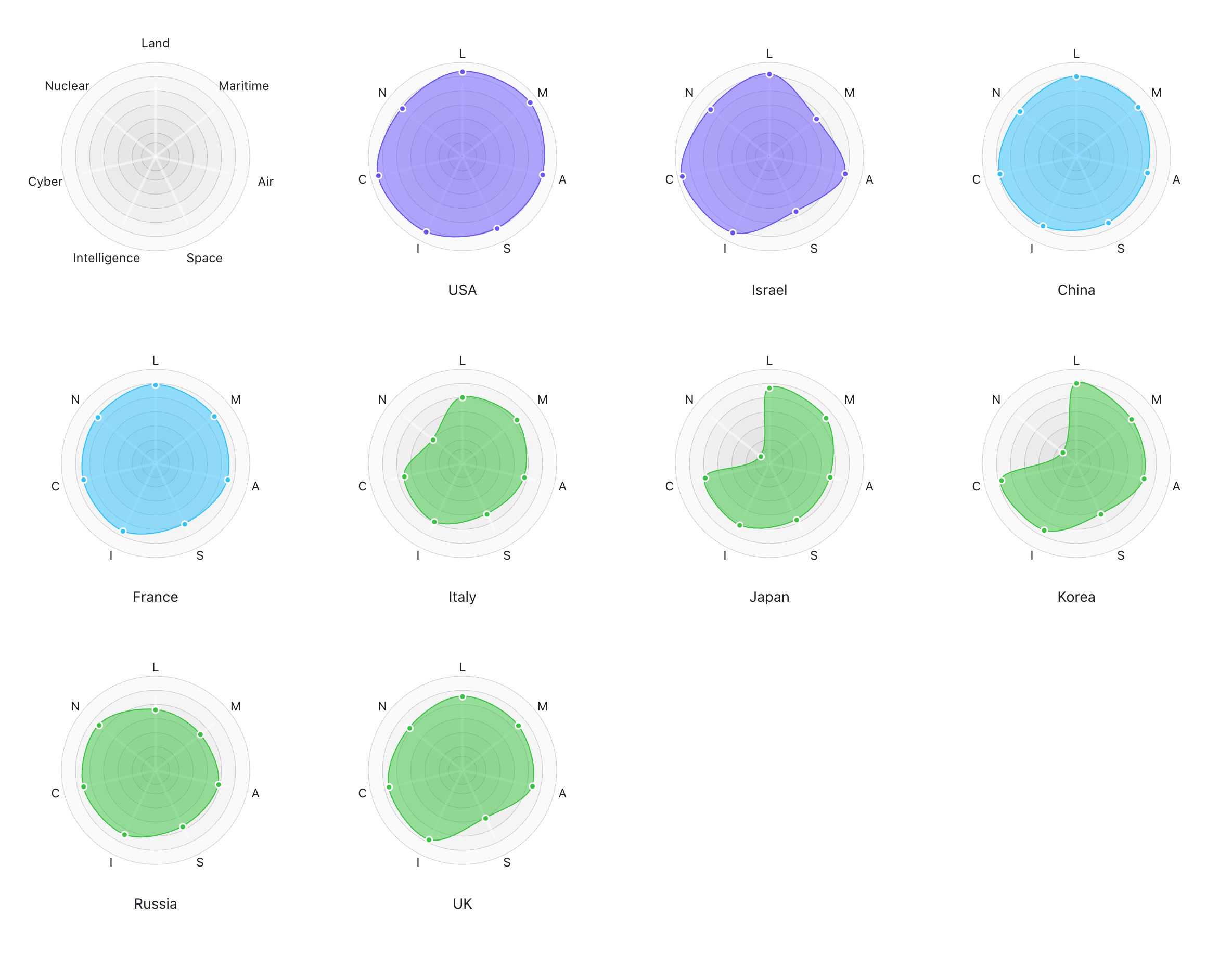
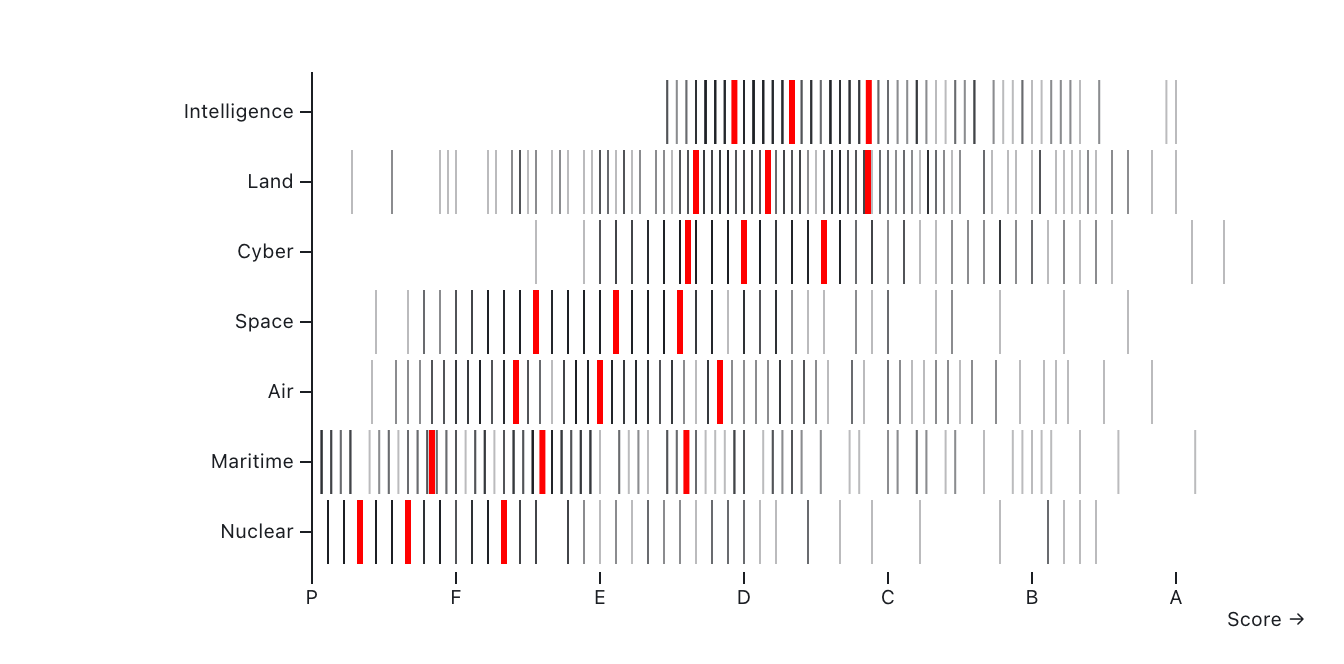
Figure 6. Global Capability Group Distribution
Land Power
Land Power encompasses six underlying capabilities spanning the full spectrum of ground combat operations, from heavily armoured formations through to elite special operations units. These capabilities range from main battle tanks and infantry fighting vehicles through to sophisticated command, control, communications, computers, intelligence, surveillance and reconnaissance systems that coordinate distributed forces across the modern battlefield.
Figure 7. Top 5 Nations by Land Power Capability Group
| Capabilities | Top 5 Ratings | ||||
|---|---|---|---|---|---|
| Armoured & Mechanised Forces | 🇺🇸 AAA | 🇨🇳 AA | 🇷🇺 AA | 🇬🇧 A | 🇫🇷 A |
| Artillery & Fire Support | 🇺🇸 AAA | 🇨🇳 AAA | 🇰🇷 AA | 🇷🇺 AA | 🇫🇷 A |
| Aviation, Rotary Wing & Unmanned Systems | 🇺🇸 AAA | 🇨🇳 AA | 🇬🇧 AA | 🇫🇷 AA | 🇷🇺 A |
| Conventional Infantry Forces | 🇺🇸 AAA | 🇨🇳 AA | 🇷🇺 AA | 🇬🇧 AA | 🇫🇷 A |
| Logistics, Engineers & C4ISR | 🇺🇸 AAA | 🇬🇧 AA | 🇫🇷 AA | 🇨🇳 AA | 🇯🇵 A |
| Special Forces | 🇺🇸 AAA | 🇬🇧 AAA | 🇷🇺 AA | 🇫🇷 AA | 🇦🇺 AA |
| Capability Group | 🇺🇸 98.5 | 🇨🇳 87.3 | 🇬🇧 84.2 | 🇫🇷 82.6 | 🇷🇺 81.9 |
Source. GINC Data Laboratory, January 2026
Maritime Power
Maritime Power encompasses five underlying capabilities spanning the full spectrum of naval operations, from blue-water power projection through to undersea warfare. These capabilities range from aircraft carriers and amphibious assault ships through to nuclear-powered submarines and advanced surface combatants that control the maritime domain and project force across the globe's oceans.
Figure 7. Maritime Power Capabilities. Frontier Nations and Global Rating Distribution
| Capabilities | Frontier | Advanced | Developed | Intermediate | Foundation | Emerging | Planning |
|---|---|---|---|---|---|---|---|
| Amphibious & Marines | – | – | – | – | – | – | – |
| Carriers & Naval Aviation | – | – | – | – | – | – | – |
| Submarines | – | – | – | – | – | – | – |
| Support & Auxiliaries | – | – | – | – | – | – | – |
| Surface Combatants | – | – | – | – | – | – | – |
Source. GINC Data Laboratory, January 2026
Air Power
Air Power encompasses four underlying capabilities spanning the full spectrum of aerial operations, from air superiority through to long-range strike. These capabilities range from fifth-generation fighter aircraft and strategic bombers through to transport fleets and attack helicopters that dominate the skies and project power across vast distances.
Figure 7. Air Power Capabilities. Frontier Nations and Global Rating Distribution
| Capabilities | Frontier | Advanced | Developed | Intermediate | Foundation | Emerging | Planning |
|---|---|---|---|---|---|---|---|
| Air Combat | – | – | – | – | – | – | – |
| Air Mobility | – | – | – | – | – | – | – |
| Attack Helicopters | – | – | – | – | – | – | – |
| Strategic Strike | – | – | – | – | – | – | – |
Space Capability
Space Capability encompasses three underlying capabilities spanning the full spectrum of orbital operations, from launch infrastructure through to defensive and offensive space systems. These capabilities range from heavy-lift launch vehicles and satellite constellations through to space situational awareness and counterspace technologies that enable nations to access, exploit and defend the ultimate high ground.
Figure 7. Space Capability Capabilities. Frontier Nations and Global Rating Distribution
| Capabilities | Frontier | Advanced | Developed | Intermediate | Foundation | Emerging | Planning |
|---|---|---|---|---|---|---|---|
| Launch & Access | – | – | – | – | – | – | – |
| Satellites & Constellations | – | – | – | – | – | – | – |
| Space Control & Counterspace | – | – | – | – | – | – | – |
Intelligence Capability
Intelligence Capability encompasses five underlying capabilities spanning the full spectrum of information collection and analysis, from human operations through to advanced technical sensors. These capabilities range from clandestine human networks and signals interception through to satellite imagery analysis and open-source exploitation that enable nations to understand adversary intentions, capabilities and vulnerabilities across all domains.
Figure 7. Intelligence Capability Capabilities. Frontier Nations and Global Rating Distribution
| Capabilities | Frontier | Advanced | Developed | Intermediate | Foundation | Emerging | Planning |
|---|---|---|---|---|---|---|---|
| Human Intelligence (HUMINT & CI) | – | – | – | – | – | – | – |
| Signals & Cyber Intelligence (SIGINT & CYBINT) | – | – | – | – | – | – | – |
| Imagery & Geospatial Intelligence (IMINT & GEOINT) | – | – | – | – | – | – | – |
| Technical & Scientific Intelligence (MASINT & TECHINT) | – | – | – | – | – | – | – |
| Open-Source & Financial Intelligence (OSINT & FININT) | – | – | – | – | – | – | – |
Cyber Capability
Cyber Capability encompasses three underlying capabilities spanning the full spectrum of operations in the digital domain, from intelligence gathering through to offensive strike. These capabilities range from covert network exploitation and espionage through to defensive hardening of critical infrastructure and offensive operations that can disrupt, degrade or destroy adversary systems, enabling nations to operate, persist and prevail in cyberspace.
Figure 7. Cyber Capability Capabilities. Frontier Nations and Global Rating Distribution
| Capabilities | Frontier | Advanced | Developed | Intermediate | Foundation | Emerging | Planning |
|---|---|---|---|---|---|---|---|
| CNE (Computer Network Exploitation / Intelligence) | – | – | – | – | – | – | – |
| DCO (Defensive Cyber Operations) | – | – | – | – | – | – | – |
| OCO (Offensive Cyber Operations) | – | – | – | – | – | – | – |
Nuclear Capability
Nuclear Capability encompasses three underlying capabilities spanning the full spectrum of strategic deterrence, from command systems through to industrial sustainment. These capabilities range from nuclear command, control and communications infrastructure and employment doctrine through to deployed warheads with delivery platforms and the industrial capacity to maintain, modernise and expand nuclear arsenals over time.
Figure 7. Nuclear Capability Capabilities. Frontier Nations and Global Rating Distribution
| Capabilities | Frontier | Advanced | Developed | Intermediate | Foundation | Emerging | Planning |
|---|---|---|---|---|---|---|---|
| Control (NC3 + Doctrine) | – | – | – | – | – | – | – |
| Force (Warheads + Delivery) | – | – | – | – | – | – | – |
| Sustainment (Industrial Base) | – | – | – | – | – | – | – |