Critical Technology and the Foundations of National Power
How advanced technologies shape power, prosperity, and resilience, have driven the rise and decline of nations, and define the current leaders in critical technology

- Summary
- Bullet
- Bullet
From industrialisation to the digital age, the rise and decline of nations has been repeatedly shaped by their ability to develop, scale, and control critical technologies.
Critical Technology comprises the advanced, high-impact technological capabilities that underpin a nation’s power, prosperity, and resilience, shaping its military and strategic advantage, economic competitiveness and growth, and capacity to withstand, adapt to, and recover from systemic shocks, while determining its freedom of action and vulnerability in an increasingly contested global environment.
Critical Technology is one of nine domains assessed within the National Capability Framework and one of three domains that comprise the Hard Power pillar. It aggregates 63 underlying capabilities, organised into eight capability groups, which together define a nation’s critical technology capacity.
Figure 1. Critical Capability Domain Overview
| Capability Group | Caps | Short Description |
|---|---|---|
| Advanced ICT | 7 | Secure networks, communications, ledgers, and high-performance computing. |
| Advanced Materials | 13 | Advanced manufacturing, novel materials, protection, and critical minerals. |
| Artificial Intelligence | 6 | AI/ML, analytics, NLP, adversarial AI, and accelerators. |
| Biotech & Genetics | 7 | Genomics, synthetic biology, biomanufacturing, and medical countermeasures. |
| Energy Technology | 9 | Generation, storage, nuclear, renewables, and directed-energy systems. |
| Position, Navigation & Timing | 8 | Timing and sensing: clocks, inertial, radar/sonar, and photonics. |
| Quantum Computing | 4 | Quantum compute, comms, sensing, and post-quantum crypto. |
| Space, Robotics & Mobility | 9 | Space systems, autonomy, robotics, propulsion, and advanced platforms. |
| Total | 63 |
National Assessments
GINC's emerging national assessments, simulate synthetic ...
Figure 2. Critical Technology Capability Tiers
| Country | Profile | Strength | Weakness |
|---|---|---|---|
| Tier 1 — Frontier Nations | |||
| 🇺🇸 United States | Asymmetric | ||
| Tier 2 Nations | |||
| 🇰🇷 South Korea | Asymmetric | ||
| 🇩🇪 Germany | Asymmetric | ||
| 🇳🇱 Netherlands | Asymmetric | ||
| 🇸🇪 Sweden | Asymmetric | ||
| 🇮🇱 Israel | Asymmetric | ||
| 🇨🇳 China | Specialised | ||
| 🇨🇭 Switzerland | Specialised | ||
| Tier 3 Nations | |||
| 🇯🇵 Japan | Asymmetric | ||
| 🇫🇷 France | Asymmetric | ||
| Tier 4 Nations | |||
| 🇬🇧 United Kingdom | Asymmetric | ||
| 🇳🇴 Norway | Asymmetric | ||
| 🇨🇱 Chile | Asymmetric | ||
| 🇫🇮 Finland | Asymmetric | ||
| 🇸🇬 Singapore | Specialised | ||
| Tier 5 Nations | |||
| 🇦🇺 Australia | Asymmetric | ||
| 🇮🇹 Italy | Asymmetric | ||
| 🇨🇦 Canada | Asymmetric | ||
| 🇦🇹 Austria | Asymmetric | ||
| 🇷🇺 Russia | Asymmetric | ||
| 🇪🇸 Spain | Asymmetric | ||
| 🇧🇪 Belgium | Asymmetric | ||
| 🇩🇰 Denmark | Asymmetric | ||
| 🇦🇪 United Arab Emirates | Specialised | ||
| 🇮🇪 Ireland | Specialised | ||
Figure 3. Capability Group Distribution
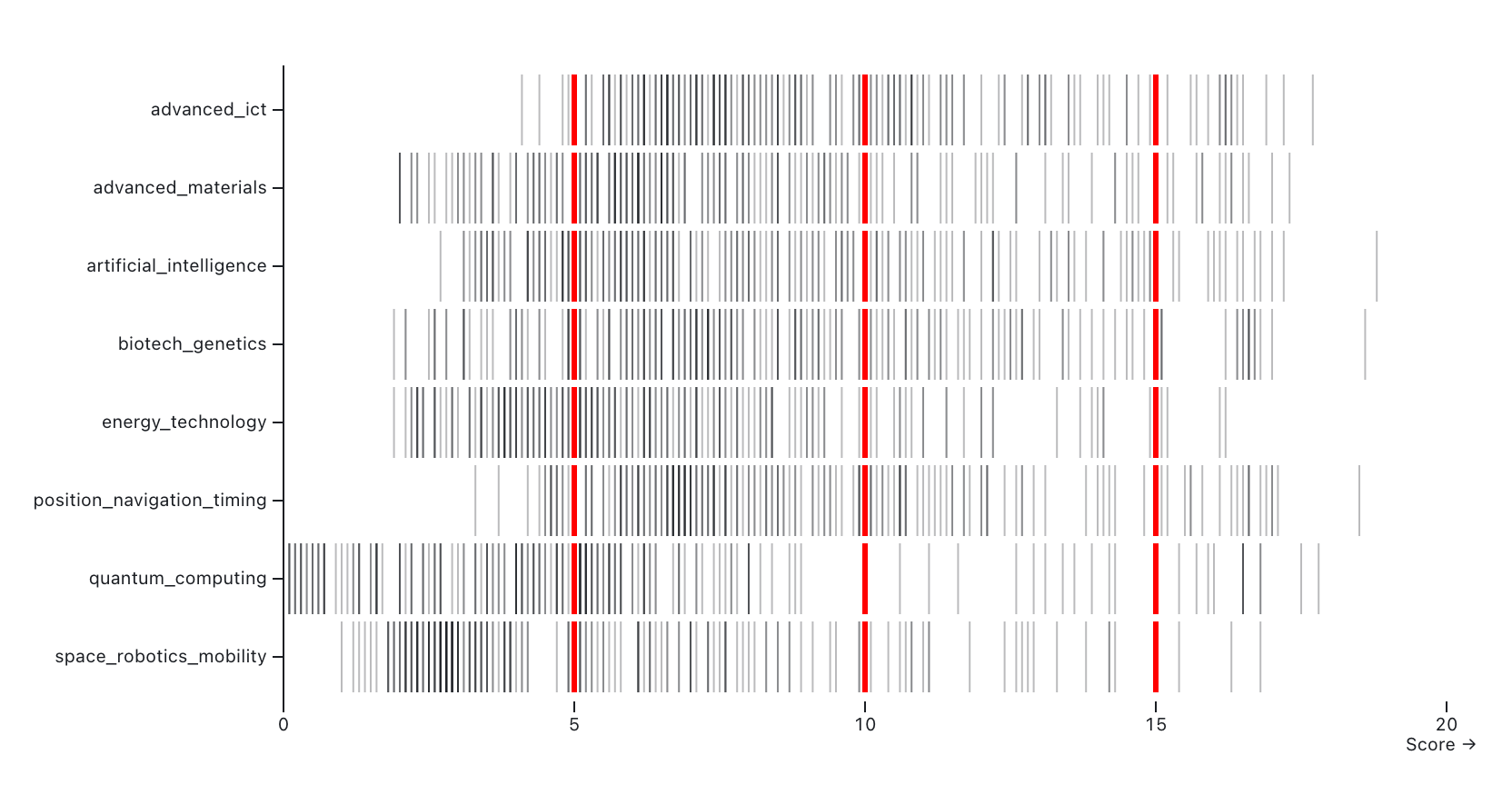
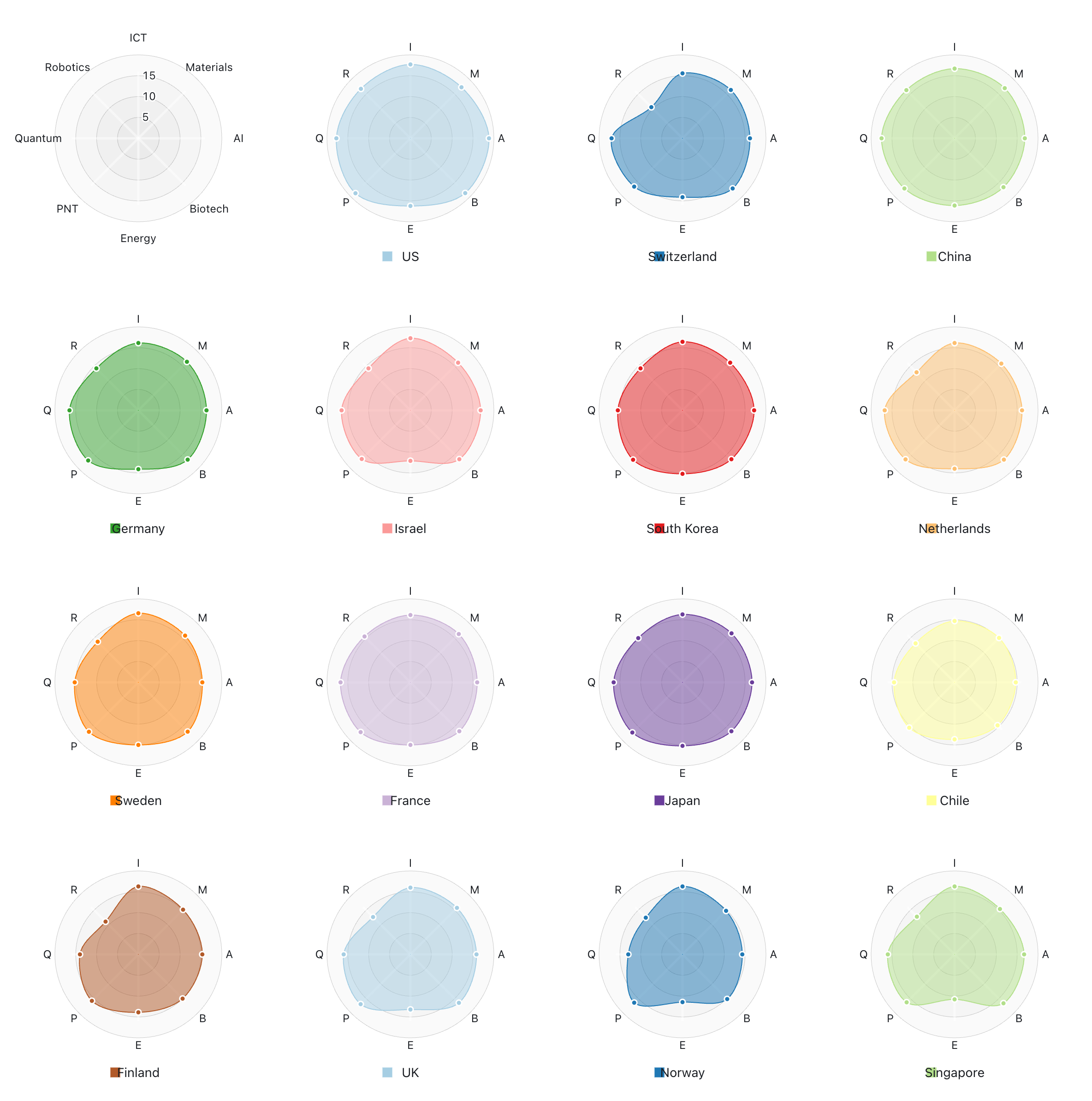
Figure 3. Capability Group Profiles of the Top 3 Tiers
Methodology