
Artificial Intelligence
Could AI Become a Public Utility?
As AI becomes ubiquitous, a fundamental question has emerged among policymakers, strategists, and investors: should AI be treated as a public utility?


Artificial Intelligence
As AI becomes ubiquitous, a fundamental question has emerged among policymakers, strategists, and investors: should AI be treated as a public utility?

National Defense Strategies
QUICK TAKE · AI SUMMARY The U.S. is pivoting from counter-terrorism to great power competition, focusing on China and Russia with a renewed emphasis on conventional deterrence, logistics, and forward-deployed forces. Future strategy depends on integrated deterrence and rapid tech adoption, requiring reforms in procurement, investment in AI and cyber,

Internships
A 10‑week, project‑based program where small teams assess three countries across the nine areas of national capability. You’ll combine top‑down hypotheses with bottom‑up indicators, stress‑test your claims through red‑teaming, and deliver a defended assessment to expert judges.
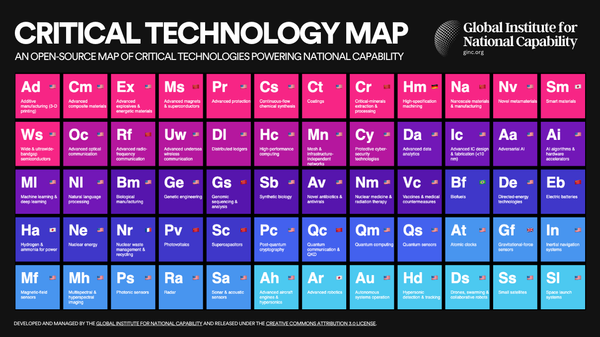
Critical Technology
💡GINC's Critical Technology framework identifies the advanced systems, materials, and processes essential for a nation’s economic competitiveness, security, and technological sovereignty. Preliminary Assessment

Critical Technology
Advanced Integrated Circuit (IC) design and fabrication at sub-10 nanometre (nm) scale represents the frontier of semiconductor technology.

Critical Technology
Advanced Data Analytics refers to the use of sophisticated techniques and technologies to extract meaningful insights from vast and complex datasets.

Critical Technology
Protective Cyber Security Technologies encompass the tools, systems, and protocols designed to defend digital assets, networks, and critical infrastructure from cyber threats.

Critical Technology
High Performance Computing (HPC) refers to the use of supercomputers and parallel processing techniques to solve complex computational problems at massive scale and speed.

Critical Technology
Distributed Ledger Technology (DLT) is a decentralized system for recording, sharing, and synchronizing data across multiple nodes or locations.

Critical Technology
💡GINC's Critical Technology framework identifies the advanced systems, materials, and processes essential for a nation’s economic competitiveness, security, and technological sovereignty. Advanced Undersea Wireless Communication refers to the technologies and systems that enable data transmission in submerged environments without the use of physical cables. Unlike terrestrial wireless

Critical Technology
Advanced Radio Frequency (RF) Communication refers to the use of sophisticated technologies and systems that transmit and receive data across the electromagnetic spectrum, particularly in the radio and microwave frequency bands.

Critical Technology
Advanced Optical Communication refers to the use of light, primarily through fiber optics and photonic systems, to transmit information at extremely high speeds and with minimal loss.